Category: Interviews

  • General Writing Questions

    1. Before you begin writing, do you script out the general outline of plot and characters, or do you let these situations evolve as you write?
    It really depends on how the inspiration strikes me.  I don’t have any hard and fast rule as to how I plot out the story.  For instance, Codename: Starkeeper was one of those where I wrote it in script format from start to finish.  It was a true explorative writing experience.  With The Last Guardians, it developed over a decade of trying different things and developing my craft, and the final version is nothing like that first version, but ultimately, it follows a similar plot outline as the beginning, as far as the big picture.  I have another novel series that I plotted out as I wrote the character sketches.

    2. I’ve heard repetitively that writers should deal with writing as any other job. Do you have a scheduled or structured writing routine? Please detail.
    I wish I did.  It really varies depending on the day, and of course I am easily distracted.  It’s certainly sound advice, though.  I will get more done if I set aside a specific time to do it.  I’ve also discovered that now, as I’ve been writing for a while, I’m so full of different ideas that if I sit down, something will get on paper (or screen).  I have also learned that it’s not so frightening to sit down and force yourself to work on a project.  There really is no such thing as writer’s block if you’re serious about the writing.  For me, it’s simply letting stuff get in my way: my brain, my emotions, my preconceptions, my self-doubts–all of that crap–once you’re serious about the writing, all that stuff will fade away because you know you have to get it done.  It’s become a priority in your life.

    3. What is your writing environment like? (cats, music, computer etc.) How has this evolved/changed?
    Depends on my mood.  I used to, occasionally, get off the computer and write on a yellow legal pad, especially on lunches and breaks in a work environment.  As far as music is concerened, sometimes I want it, sometimes I want silence.  My cat’s always around, but she just lays on the bed.  I don’t take any great measures to “get in the mood” to write or anything like that.  Focus too much on music or lighting, or “finding the right environment,” and you’ll become dependent.  The less you do, the more capable you will be of writing in any environment, and I think once you’ve made writing a priority, you need to be prepared to write no matter where you are, or what’s going on around you.

    4. Do you write anything, or have you, that is solely for yourself? (no intention of sharing with a large audience)
    Not any more.  When I first really got the writing bug in college, a lot of it was just putting ideas on paper because they were there.  I got started online in the role play chatrooms, and it was usually all fantasy-oriented, so I put myself into the whole Aragorn persona, and plot ideas just developed out of that.  Eventually I started working on stories, and different things would inspire novel ideas, for example, the track listing of Michael Flatley’s Lord of the Dance, believe it or not, inspired the plot of The Last Guardians way back when.  Now, when I conceive an idea, I immediately begin thinking about how it will be received, and how to make it worthy of public consumption.

    5. How has social media played a role in your writing?
    Not so much the writing, but certainly the promotion of it.  I’ve just simply tried to make a network of friends, rather than “contacts.”  Because a friend will invest themselves in what you do, if you invest yourself in the things they do.  Someone who only wants you as a “contact” that they can take advantage of, really has little concern with your own projects, but simply how they can leverage their support in your return of that support.  It sounds like the same thing, but if you support people without expecting something in return, people can see whether you’re sincere, or just out to get reciprocation.

    I’ve made a lot of friends using Twitter, simply finding like-minded people in the podcasting community, and then having gone to Balticon just once, made so many more friends.  Once you’ve met people face to face, the friendship becomes that much stronger.  I’ve developed relationships with Tee Morris, Chris Lester, P.G. Holyfield and Christiana Ellis, just as an example, and at times we can bounce ideas off of each other, and just learn from what each other is doing.

    Podcasting Questions

    1. What type of OS do you prefer? Linux? Mac? Win? What are your machine’s specs?
    I would *prefer* a Mac and ProTools, but that’s only in my dreams.  Finances necessitate a PC with as much free software as possible.  It’s just a Dell 3Ghz processor with 1GB of Ram and a 250GB Free Agent HDD for all my project files.

    2. Would you please describe your current studio? How has this changed? (What did you start with?)
    I have a cheap desk in my bedroom.  I have a down blanket hung on the wall behind the monitor, with a little bit of eggshell foam on a dresser beside the desk.  A TAPCO (by Mackie) Mix.60 mixer, an MXL 990 microphone and a pop filter.

    3. If you were able to build your dream studio, what would it include? Be as specific as you wish.
    Again, a Mac with ProTools first, a compressor/limiter/gate, an EQ, a Heil PR/40 with the desk boom, a suitably insulated and soundproofed room, and most especially, a soundproofed computer.  Also an off-board recorder.

    The Heil PR40 is something I’ve discovered of late, and it’s a dynamic mic as opposed to a condenser.  Basically that means it doesn’t require Phantom Power, but the other part of that is that condenser mics take in a lot more background noise.  The Heil PR40 has a tight sound field so that it almost can’t pick you up if you move your mouth six inches in one direction.  It’s an expensive mic at $325 retail, but it’s probably the absolute best microphone for recording voice.

    4. Other than a computer, what piece of HARDWARE would you recommend to a new podcaster?
    If you use Skype at all, I’d recommend a second sound card.  But for everyone, I’d suggest a Zoom H2 or later, or some sort of portable recorder that gives you .wav or .mp3 capability.  It’s the aforementioned off-board recorder.  What I mean by that is something that is not plugged into everything else.  This is something I’ve learned sort of by experience.  When I first started podcasting, I discovered that if my laptop were plugged in, there was a lot of noise on the recording, but on the battery, it was quiet.  So when the laptop HDD went bad and we lucked into a couple desktops, I found that there is always a latent hum.  If you can get a power conditioner, that might eliminate most of it, but a battery-powered recorder gives you a lot of versatility.  Also, if you don’t have your signal bouncing back in through your mixer into the PC, it’s a lot easier to get clean recordings.  When doing panel discussions or Skype interviews, anything requiring multiple voices, it becomes easier to manage the unity gain of your output signal.  If you’re just recording your voice, then you’ll have a clean .wav or .mp3 of your voice you can dump down into Audacity or whatever and edit away.

    5. What have you had to learn for yourself that you wish someone could have warned you about?
    To go with “The Adventures of Indiana Jim” as my show title when I first thought of it.  I initially thought it was pretentious so I didn’t use it at first.  Really, it’s the branding.  You have to have a plan, and you have to know who you are.  When I started out I wasn’t sure what I was doing, and over time, I have developed a groove for it I suppose.

    6. What would you consider a “beginner’s mistake” you’ve either experienced or hear others making?
    Oh gosh, a lot of things.

    #1, a failure to have an appealing website.  It’s so cheap and so easy, especially for my generation being so tech savvy, to look at other podcast websites and find a clean, inviting format for your website.  A .net domain you can buy for like $10 a year, and hosting for about $3 a month, and WordPress is free.  I am fortunate to be hosted by Farpoint Media, but you can buy a 100MB per month Libsyn account for file storage for $5 a month.  So for $8 a month and $10 a year, you can put up a website as nice as any other you can think of.  Take the time to learn a little CSS, and you can make that puppy sing.

    #2, a failure to USE RSS.  I see so many beginners, believe it or not, or people who just haven’t taken the time to care, to have an RSS feed for their products, and still expect people to download things manually.  It’s so simple to set it up, so people can subscribe in iTunes or any feed reader.  You’re simply serving your audience by doing it.  In one place, with one application, I can download my favorite stuff.  I sounds so simple.

    #3, a failure to use social media.  I have friends with Twitter accounts who simply forget to announce when a new project comes out.  When I mention this, I’m met with “well it was all over my website.”  Look, if you expect your friends and colleagues to casually browse by your website every so often and “discover” that you have a new product out, you’re doing them a disservice, and ultimately yourself.  The idea is to be heard, and you, as the creator, must do the work, not demand it of your audience.  If you aren’t using every tool at your disposal, you’re not doing enough.  Now that’s not to say you need to be on every social network under the sun, but if you are on Twitter and Facebook, and you’re not doing the simple thing of just posting a link saying, “here’s my new thing,” then what’s the point?

    #4, a horrible sound.  Sometimes beginners use whatever it is they have at their disposal, and I guess that’s fine when starting out, but people really need to be more conscious of how they sound.  Soundproofing is the very first thing one can do, and Nathan Lowell is a good example.  When he started podcasting his novels, he recorded them in his car.  A car interior provides quite a bit of soundproofing and isolation, and that worked wonders, despite having a cheap microphone.  Another example of using the things at your disposal is Scott Sigler.  He recorded a lot of his stuff in his closet, because he cared about his sound.

    If someone is serious about podcasting, then they need to be serious about what they’re putting into people’s ears.  It takes maybe $130 in mic and mixer to get a decent sound, maybe $35 for a cheap mic stand and a pop filter.  It’s not a ton of investment if you’re serious.  Also, paying attention to distance from the mic, clipping, and simple public speaking.  These little things make a huge difference when starting out.

    7. How much time does it take, once you have all the elements, for YOU to put together a 30 minute podcast? (please describe your production technique)
    I would love to record “live to tape” as it were, but I lack the equipment to do it right.  So what I do is insert my intro file, then do the requisite recording, whatever that entails.  Most of the time I’ll record 10 minutes of whatever I want to talk about at first, then I stop to add the bumper for my little news headline segment, then when that section is done, I’ll usually aim for that 13 minute mark to hit the break for the promo.  I’ll take my bump-out file and match it up with wherever I break the talking, then paste the promo, then paste the bump-in file, and record from there.  I will record to the end and stop.  Before I put in the outro, I do the editing.  I run noise reduction, then compression.  I usually record with my levels hovering around the -12 mark to leave headroom so I don’t clip.  That usually ensures I get a nice clean sound after compression.  I’ll edit certain flubs and long uhmms to make sure I don’t sound too much like an idiot.  Sometimes I leave a flub or uhmm in if it will make the audio sound chopped up and unnatural.   I’ll match the outro up with the finished voice and then export to MP3.  That whole process may take a couple hours if everything goes smoothly.  I think for the ratio of finished recording to  production time, 1:4 is probably a safe estimate.

    Casting Questions (answer if you can)

    1.  What is the hardest part of putting together a casted podcast?
    I think the first thing is making sure the actors get their voices in on time.  It’s unavoidable, but you will always get delays from someone in your cast.  Real life always strikes in the middle of a production, and I guess the hardest part for me is having to tell a cast member you have to move on with another actor.

    It’s the nature of what we do to use volunteer voice actors, and no one wants to be “that guy” who “fired” a volunteer from a project.  You have to believe strongly enough in your project and your own schedule to take that step if it’s not working out.    You have to be very nice and gracious about it, and usually the other person understands.  They are, after all, the one to whom life is happening.  It’s still difficult, especially if you know their voice would be great.

    The second hardest part is the differences you have in actor audio.  They’re all using different mics in different rooms, and sometimes it’s difficult to make sure they all go together.  I usually have a particular sound I like, so I’ll EQ or do noise reduction to get each one as close to the same as possible.  Sometimes I’ll run a low pass or high pass filter to get certain frequency ranges out of a particularly bassy or hissy sound.

    2. Do you provide the entire chapter to your talent, or just their lines?
    I will usually leave in a paragraph or two around the part in order for the actor to get a feel for the scene, but I provide the scene only.  Enough to let them see the dialogue and work with it, but not so much they get distracted.  My belief is that even with my leads, it’s fun to keep things hidden from them.  I find that if after the recording they get to listen to it along with the general audience, it will make them that much more excited about the work.  They will get just as much into the story, and they’ll want to see how their character fits into the story.

    3.  Is instruction given to your talent on how you prefer the line to be read?
    In most cases, yes.  Each actor is different, though.  For instance, I did not do a very good job telling Mae Breakall how to play a certain character, and so she read it one way when I had intended it differently.  Once I was clear, she delivered some of the best audio I’ve ever received, and Chris Lester can attest to that with her work on Metamor City.  As a director, you have to make sure you are clear on exactly what you want, because you can’t expect people to read your mind.  Of course, in some cases you simply give the lines and the actor knows what you want.  I have that kind of synergy with a few people, such as Philippa Ballantine, P.G. Holyfield, Sarah Gilbertson and Joe Harrison.

    4.  What do you do with all of that unused audio?
    I still have all the original files from Codename: Starkeeper, and I don’t really want to delete them.  I plan on going back and pulling outtakes for a blooper reel, but that’s going to take a lot of time.  What I’ve taken to doing now is pulling the outtakes out as I go through each individual part to get the best takes.  I’ll go through each part and find the best takes, then do the noise reduction and compression then, so that all I have to do later is cut and paste into the final project file.

    With Codename Starkeeper, I’m keeping the sound effects files that Joe Harrison made so I can pull from those whenever I do another Star Wars piece.  The music files I’m keeping later perhaps to show how I edited different musical pieces from different films together in certain scenes.
  • Arlene Radasky is the author of The Fox as well as short stories and poetry. She is also a proud grandmother of new baby boy!

    General Writing Questions

    1. Before you begin writing, do you script out the general outline of plot and characters, or do you let these situations evolve as you write?
    Before writing I do not outline. I “see” the story in my head, and then write it. The written scene evolves around the scene in my head.

    2. I’ve heard repetitively that writers should deal with writing as any other job. Do you have a scheduled or structured writing routine? Please detail.
    Writing for me is not a job. I do not need nor wish to create a money stream from it.(Although, I would not refuse any $$!) It is much more a love, a need to follow the thoughts in my head. I am new to this so I am still experimenting. My life is in a state of change right now, so the bit of regular writing time is not available as easily, but I hope to create a niche for it soon. However, when a thought strikes me for a short story or a poem, I can get it done very quickly. It is the researched novel that is time consuming.

    3. What is your writing environment like? (cats, music, computer etc.) How has this evolved/changed?
    I write in a comfortable chair and in a comfortable room surrounded by cats and coffee. I do have a laptop and at times, especially when working on my novel, I take my computer out on my front porch where I can see the mountains, or in my car to the beach and watch the waves.

    4. Do you write anything, or have you, that is solely for yourself? (no intention of sharing with a large audience)
    I wrote a notebook filled with my thoughts and what was happening around me when my father was killed in a car accident. I have not shared that with anyone. I also have notebooks filled with events around the disasters I worked on when I was with the Red Cross. I have not shared those.

    5. How has social media played a role in your writing?
    Social media has been important in my writing. I was a member of a writers’ forum while writing The Fox and enjoyed the support, critiques and support. I suppose I would have found that available, especially through my local library, however, to be able to do critiques and respond to them on my own time was valuable to me. Now, the media is my connection to the huge writing and recording community of the world.

    Podcasting Questions

    1. What type of OS do you prefer? Linux? Mac? Win? What are your machine’s specs?
    I have recorded everything I in GarageBand on a MacBookPro, now with 500 Gs of memory as recording takes up so space until done.

    2. Would you please describe your current studio? How has this changed? (What did you start with?)
    Studio? LOL I worked in a corner of a bedroom with beds around me and carpet on the floor. I am thinking of making a screen of cardboard lined with egg-crate foam, but have as yet to do it.

    3. If you were able to build your dream studio, what would it include? Be as specific as you wish.
    Since I am a rank amateur, I would have to have some else design and build a dream studio.

    4. Other than a computer, what piece of HARDWARE would you recommend to a new podcaster?
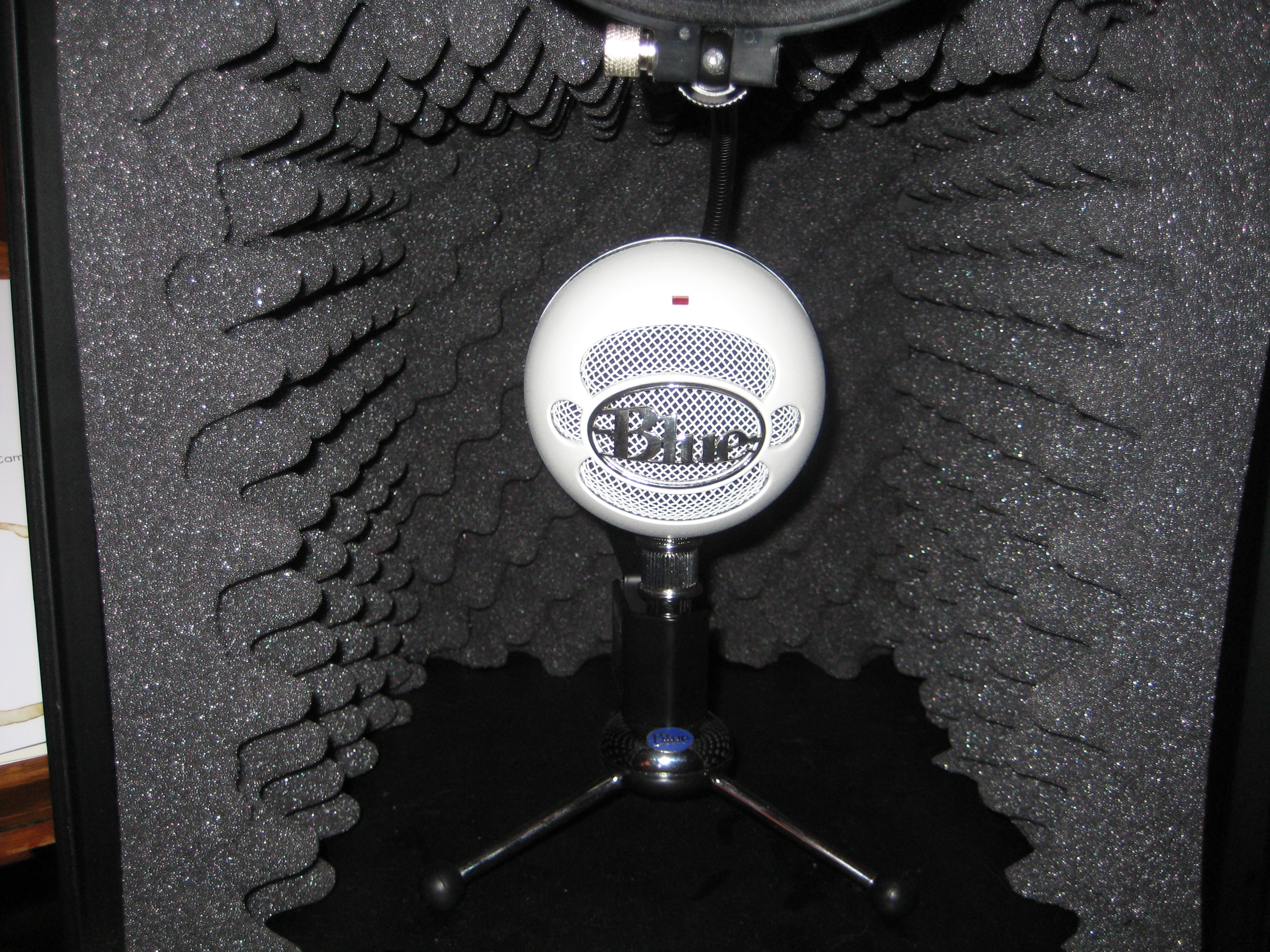
    I recommend a good USB mic, mine is a Blue Snowball.

    5. What have you had to learn for yourself that you wish someone could have warned you about?
    I use levelator. I know some pros hate it, but for me, it works. I wish I known how to use it in the beginning. I also wish I had rerecorded the first 5 chapters before I released them, but it the product was not horrible so even though I did rerecord and release them, I was not too embarrassed by the first attempt.

    6. What would you consider a “beginner’s mistake” you’ve either experienced or hear others making?
    Editing while recording is very easy in GarageBand. I was able to go back and record over my mistakes. I have talked to those using Audacity and it is not as easy. I hear left in mistakes and duplicated sentences, at times even swear words left in because they were not identified in the editing process. One author has told me that she snaps her fingers or makes a cluck with her tongue to make a spiked wave so she can find her mistakes. Others don’t do this. I smile at the mistakes but there are some books with several in each chapter or episode and it gets old.

    7. How much time does it take, once you have all the elements, for YOU to put together a 30 minute podcast? (please describe your production technique)For a 30 min, straight read recording, no sound effects ++ To set up the mic, music stand to hold my material and computer, to get the program ready to use, record for about 60 to 90 mins., listen through and make corrections two times, turn into AIFF and levelate, add intros and music, listen, turn into mp3 and listen one more time, takes about 3 1/2 to 4 hours.

    Casting Questions

    I have done only a bit of one or two short stories, casted. I also put a short promo together. Whew, talk about time consuming and intense! I have to decide what read sounds the best where, find it and then insert it. Add 2 hours on to the process, at least for a short story!  I do like the outcome, however. So far I have kept the outtakes along with the stories. However, they also take up memory space.

    General Questions

    1. If someone approached you with THEIR book, and asked you to podcast it for them for a fee, what would you consider a reasonable rate per episode? (The way YOU do it)
    How much to charge for doing a podcast for someone else? Whew, that is tough. It takes so much time that I would be severely limited in the time I would have for my projects. I do volunteer to do recording for free for some shorts but I don’t know if I would do a novel for someone. I would have to think deeply about the fee and why I would even think of doing it.

    2. Do you podcast as part of a larger plan, or because getting your content out in some manner IS your plan?
    Getting my story out and read/listened to was and is the larger plan. I started by distributing it for free on sites that allowed free PDFs and then ventured into recording. Podiobooks.com is the vehicle that allowed me access the listening audience.   I always plan on writing and recording my content and there are many ways to get it out to the world in these forms.

    3. What is the nicest compliment you’ve been paid or what keeps you coming back?
    I have two that stand out in the flood of compliments. I get them often. The first is that the reader/listener cried and the second is that my research shows and is accurate.  I get many more compliments but my heart beats a bit faster with these.

    4. How important are numbers of downloads/subscribers to you? Do you keep track?
    I do keep track of how many downloads I have. I think it is a bit of a pat on the back. I know many others are doing it to attract offers from publishers, however, since my book is free in most places, I do it for myself. And I like to know where it is being seen.

    5. How important are reviews left on Podiobooks/iTunes/other venues to you?
    Reviews are the authors pat on the back or a kick in the butt, which ever way they go. We all like to know our work is being enjoyed and need to know if there is a problem. Reviews are very important to me.

    6. If not answered previously, how do you read your manuscript while recording (hard copy, teleprompter, etc)?
    I have a music stand to prop my large-font printed pages on to read from and stop recording as I move or drop a page.

  • Title: The Nifty Tech Blog
    Author: Doc Coleman
    Genre: Reviews
    Released: February 2010 to present
    LocatedAuthor’s Site
    Formats Available: blog only at this time
    Rating: G for techie goodness

    As many of you are aware, and quite possibly participated in, there was an auction event earlier this year with the proceeds to benefit the daughter of podcasting legend and all around good guy, Tee Morris. The auction, known as The Boom Effect, named after the young lady known as Sonic Boom went off without a hitch. More money was raised than could have been hoped and has been reported to be in Trust for her. It truly was nice to see the community come together and in such a wonderful way.

    As part of the auction, Richard Asplund Jr. (of Random Pimpage) and I submitted a lot where the lucky (courageous) bidder would be simultaneously ripped to shreds, I mean discussed, on both of our blogs. The Nifty Tech Blog was the winning bidder and both Rich and myself appreciate the generosity shown in taking a chance on us and helping in this cause.

    Unfortunately, what happened next was a fumble. Yup, believe it or not, two vikings do not a genius make. We both ended up with issues that prevented us from providing the intentioned smashing of the winner’s content. So, you will get my take on it here, and Rich will be providing his “over there” when time allows.

    So, on to the review.

    Synopsis: The Nifty Tech Blog is all about, you guessed it, nifty tech! Even before the auction I was a fan of the site, so it was easy for me to get excited about the prospect of reviewing the site.

    Production: The production over at Nifty Tech is very nice. The red and cream colors and stenciled borders are particularly appealing. I have also always been a fan of “seriffed” fonts. Thankfully, Nifty Tech has foregone the use of a The Story So Far devise. On a blog, that would really be a mess.

    Cast: The cast over at the Nifty Tech is a mixture of a one man show and an all star lineup! And what a lineup it is: Dropbox, the iPhoneGelaskinsBluBridge Auto – TalkCrash PlanGoogle Voice,  OmnifocusiPadGrocery Gadget, and iTunes.

    Story: At Nifty Tech, the story is the cast. Without fail I can say that all of these stars are top notch in their fields and I employ six of the ten myself. I especially adore Dropbox which I use daily. Another notable fact is Nifty Tech’s willingness to employ newbies and unknowns. As a matter of fact, the BluBridge Auto-Talk was written by some guy that goes by Odin. While the product is stellar, the writing style was rather subpar for the site [ed note – yes, that review was written by me].

    Verdict: All kidding aside, The Nifty Tech Blog is a fantastic site and a great resource for all your technical interests. I highly recommend it and suggest you check it out. Not only that, but Nifty Tech is always looking for new products and willing guest reviewers are happily considered. Please run by there and see what they have to offer.

    Disclosure: As mentioned above, this review is being provided in an effort to make good on payment rendered. I would like to state however, that I truly endorse The Nifty Tech Blog and label them as required reading.

  • Starla Huchton currently lives in Monterey, California with her husband, three children (minion v1.0, v2.0, and v3.0) and FAIL DOG, the black lab. She is currently pursuing a degree in Graphic Design. Her other part time job consists of live shows over streaming internet radio, where she sings jazz standards and modern tunes for venues in the virtual world of Second Life. She is very talented, if she does say so herself. Samples of her melifluousness can be found on her MySpace musician’s page here.

    Ms. Huchton has been writing off and on since she was itty bitty, but completed The Dreamer’s Thread in late 2008 under the insane pressure of National Novel Writing Month to propel her. With the encouragement of her family and friends, she pushed forward with her obsession with sharing her stories with the world.

    Previous to her present situation, Starla was enlisted in the United States Navy as a Lithographer (a glorified name for someone who runs a Xerox machine all day). She lived in Keflavik, Iceland for four years where she discovered her passion for design, and Sasebo, Japan for two, where she actually had a real job as a designer. After returning to the United States, she resided near Seattle, Washington where she discovered a love of pad thai and an unnatural abhorrence to PTA meetings. Despite all this moving, however, she calls Grapevine, Texas her home. HOOK ‘EM HORNS! [ED note: stolen from her site, I have no particular affiliation with any Texas team] [Go Cowboy Joe! (look it up)]

    General Writing Questions

    1. Before you begin writing, do you script out the general outline of plot and characters, or do you let these situations evolve as you write?
    Outlines are for sissies!

    Only kidding. But no, I plot develop as I write. There’s something I love about discovering the story as the characters do. I find that once I’ve written down notes about where the story’s going and decided how it ends I’m not really inclined to do the actual writing anymore. Creating a new world is an adventure that is best enjoyed through the eyes of the people in it. I can put myself right there with the characters and feel what they feel as the events unfold. That’s one of the magical qualities of the written word.

    2. I’ve heard repetitively that writers should deal with writing as any other job. Do you have a scheduled or structured writing routine? Please detail.
    Pardon me for a moment. I’m too busy laughing to answer this question seriously.

    (Ahem) If I were getting paid to write, maybe. As it is, at the moment I’m typing with one hand and holding a baby with the other. So, really, I just squeeze in time when and where I can.

    3. What is your writing environment like? (cats, music, computer etc.) How has this evolved/changed?
    Ideally, peace and quiet and my laptop are the only ingredients I need to get some words out. But with the scarcity of peace and quiet, I substitute tea and chocolate instead. If I need audio distractions, I’ll put on something instrumental that’s appropriate to the scene/project. Nothing with lyrics, because I’ll just start singing along and nothing gets done. It’s like musically induced ADD. My time as a dedicated writer has been pretty short-lived, so there’s not been much in the way of evolution of that setup. The key is to be flexible as I also move every couple of years.

    4. Do you write anything, or have you, that is solely for yourself? (no intention of sharing with a large audience)
    I’ve got piles of bad poetry from when I was an angsty teenager that I don’t generally inflict on other people, but aside from that, there are no finished bits of writing hiding out that I’m keeping for myself. I’ve got notebooks and files of unfinished projects I may someday use or finish. Those go unshared because they’re more or less dead projects.

    5. How has social media played a role in your writing?
    Social media has furthered my writing in ways I never thought. Before, it was just my lonesome self dabbling in creating stories, but with the introduction of Twitter and podcasting and SecondLife and all the rest, I’ve come to know other writers who do it “for real”. This has changed my views and dedication to writing a hundred fold. Being able to bounce ideas off other authors and getting feedback from them makes all the difference. Without social media, I wouldn’t have the pleasure to know half of the people I’ve met in the last year. It also would have resulted in a much different cast for TDT, or no cast at all. So there’s that too.

    Podcasting Questions

    1. What type of OS do you prefer? Linux? Mac? Win? What are your machine’s specs?
    It’s Mac or nothing for me. I’m currently running Snow Leopard on my Intel duo core MacBook, but it’s several years old so I’m planning an upgrade this summer… to a new Mac, of course.

    2. Would you please describe your current studio? How has this changed? (What did you start with?)
    My “studio” as you could loosely call it, also doubles as a baby nursery. I don’t have the luxury of setting up anywhere else in the house, so this is it. My own little corner. Literally, a corner. And for anyone who’s heard the blooper reel of The Dreamer’s Thread podcast, they’ll know that I have no insulation from outside traffic/airplane/woodpecker noise and I curse this regularly. My equipment consists of an Alesis 8-track mixing board (though this is overkill as I only use 1 track), a Shure PG58-XLR microphone, a boom mic stand, pop filter and my MacBook. I do my recording in GarageBand (please no throwing tomatoes!). After trying a few other programs, it was just the easiest to use and does everything I need it to. I hit record and begin reading from whatever script I’m working on that day. Easy peasy.

    3. If you were able to build your dream studio, what would it include? Be as specific as you wish.
    For what I do, my current equipment is just fine, but it would be lovely to have a soundproof booth to hide in. External noise is the bane of my existence. No dream studio would be complete without a built-in audio engineer to do the editing for me! Fortunately, I was lucky enough to have a good friend, Jamie Jordan, do the production for The Dreamer’s Thread, so I guess I’m halfway there!

    4. Other than a computer, what piece of HARDWARE would you recommend to a new podcaster?
    There are so many options out there, and I don’t know too much about them to make that call. I like what I’ve got, so I’d recommend that, but other than that I’d tell them to do lots of research and figure out what’s going to work best into their budget and audio needs.

    5. What have you had to learn for yourself that you wish someone could have warned you about?
    Actually, I feel like I was pretty well-informed about everything. There weren’t any huge issues that blindsided me. Maybe I was just lucky, but I think that’s due mostly to all the great advice other folks gave me before I started and working with someone that had done podcasting before (Jamie produced Mur Lafferty’s Playing for Keeps podcast as well). The community is surprisingly supportive of newcomers, which, I suppose could take you by surprise. Warning! Helpful people ahead! Shocking, I know.

    6. What would you consider a “beginner’s mistake” you’ve either experienced or hear others making?
    Audio quality! Listen to other podcasts and see how they sound. Listen to LOTS of them! When you’ve done this you can easily judge where your audio falls on the quality scale. This is much more difficult to be consistent with when doing a full-cast production as other people’s equipment isn’t necessarily the same or as good as yours. Ah! There’s something you can put under the last question! All mics are not created equal!

    7. How much time does it take, once you have all the elements, for YOU to put together a 30 minute podcast? (please describe your production technique)
    With a full cast production, it takes much, much longer to put together a thirty minute podcast than it does when only one person is doing the speaking. It takes me roughly two hours to do the recording for the main narration, but then it went on to production where Jamie had to clean up not only my audio, but cast lines as well before integrating them into the main track. And then there’s inserting the music and building the intro and outtro… well, depending on how many character lines there are that week, it can take two or three days to complete. And that’s for a week with no missing audio files or other issues. It’s pretty time intensive.

    Casting Questions (answer if you can)

    1. What is the hardest part of putting together a casted podcast?
    I wouldn’t say there’s a hardest part, as it’s all pretty challenging. First you have to find the right voice for each character (and pray you didn’t miss any!), then you have to send out the “throwing myself upon your mercy” emails to each individual (I hated that part. I don’t like asking people for things, especially strangers.), you have to portion out all the scripts and highlight each character’s lines, send out said scripts, hope you get all the audio in time (lucky for me I had a bunch of people who preferred to be early!), then there’s the sound quality issue sometimes, and files get lost. It’s all a HUGE undertaking and a big hassle, but the end product is so very very worth it. I can’t imagine my story any other way now. As a bonus to the great end product, I got to know some fantastic people too.

    2. Do you provide the entire chapter to your talent, or just their lines?
    I provide each person with the scenes their character appears in, but not the entire episode text. There are a few reasons for this. The first being practical purposes, as it’s just easier for the reader to not have to search through pages and pages of text if they only have a few lines in that episode. The other reason is so that even the cast members don’t know the whole story before the episode goes live. I’d like them to be able to enjoy the adventure as well. No spoilers!

    3. Is instruction given to your talent on how you prefer the line to be read?
    Yes and no. Mostly no. When they first sign on to do a part, I give them a character run down so they have an idea of how to play it, but after that, I let them have at it. Many of my cast members expressed surprise at this lack of direction, but I enjoy hearing how others see and interpret my characters. Each little bit of audio I get is like a new insight into the fictional people I created. It’s a fascinating process. Maybe I was just really lucky, but all the compliments I’ve gotten about what a great job (insert cast member name here) did speaks volumes for the talent of my voice actors. As many of them were writers themselves, I think that helps.

    4. What do you do with all of that unused audio?
    What unused audio?

    Just kidding. Really, there wasn’t too much audio I didn’t use for TDT, but what oopsies I had went into the blooper reel that released at the completion of the podcast. Some of the talent opted to cut out their bad bits and only send us the usable lines, but I did get a few gems that made me chuckle.

    5. What is the hardest part of putting together a “straight read” podcast?
    Not entirely sure what is meant by “straight read”, so I’m opting not to answer.

    6. As far as cast goes, what would you like to try, but haven’t so far?
    After the TDT cast list was filled, I heard a whole gaggle of new voices I wish I could have used for that project. Also, there were some folks I would have liked to use more extensively, but as it was my first foray into podcasting/novelling, I didn’t feel comfortable asking some of the busier people to voice larger parts. Next time around I don’t think that will be as much of an issue, so prepare to hear more of some familiar voices (yeah, I’m talking about you, Mr. Morris. ;P).

    General Questions

    1. If someone approached you with THEIR book, and asked you to podcast it for them for a fee, what would you consider a reasonable rate per episode? (The way YOU do it)
    As I didn’t put TDT together myself (that Jamie Jordan magic touch really made it shine), it wouldn’t really be right of me to put a price tag on his services. He says it would vary from project to project, and I think that’s a good answer. Also, as my cast members all donated their time and talent, I couldn’t really ask them to do so again if I was getting paid. So, when you add up voice talent + audio production costs… well, it might get pricey.

    2. Do you podcast as part of a larger plan, or because getting your content out in some manner IS your plan?
    Getting it out was really the plan for this book. Would I like to be picked up for publishing? Of course. That’s a given, but for me it was more about sharing the story with others. What’s the point of writing fiction if it just sits there and no one ever gets to enjoy it? The Dreamer’s Thread will eventually be available in print on demand and ebook versions, as some have requested it, and I’ll be querying agents and publishers as well. You’ll never know what can happen if you don’t try.

    3. What is the nicest compliment you’ve been paid or what keeps you coming back?
    The compliments that really make my day are the ones I get from other writers I admire. Of course, it’s always a treat to hear good things about TDT from anyone and I don’t want to belittle those other comments. Just knowing that more than my mother is listening to the podcast makes my day. And I’m not gonna lie, I’m an attention whore. Podcast feedback feeds my “LOOK AT ME!” addiction. LOL

    4. How important are numbers of downloads/subscribers to you? Do you keep track?
    Any podcaster that tells you he/she doesn’t keep track of downloads/subscribers in a general sense is lying to you. Having proof that people are listening is what keeps you in the game. If the podcast is a work of fiction and really successful (or even moderately so), it can be a good point to include in a query letter to publishers. It might not translate directly to sales, but it’s proof that the content is marketable.

    Huge numbers aren’t my all-encompassing goal, but I do check in at least once a week to see my stats. I like to have a general sense of how things are going. My definition of success may not be the same as another podcaster’s, but I’m quite satisfied with how I’ve done to date.

    5. How important are reviews left on Podiobooks/iTunes/other venues to you?
    It’s more important than people think. I’ve started listening to podcasts because the description sounded good, but abandoned them soon thereafter because something about it put me off; started slow, narrator’s voice was too annoying, sound volume was inconsistent, etc. If there were reviews to check out before I downloaded, I might have known about those issues and been prepared or not wasted my time if it was a bad podcast. That’s as a listener. As a podcaster, good reviews are a huge ego boost, and bad reviews a challenge to do better next time. Whatever they are, I try to take them positively, and not too seriously. Perspective is important.

    6. If not answered previously, how do you read your manuscript while recording (hard copy, teleprompter, etc)?
    If you’ve listened to the blooper reel on The Dreamer’s Thread, you’ll know I read off of a Microsoft Word document on screen as I record. I curse it routinely, but for the most part it works just fine.

  • T.M. Camp is an all around good egg and the author of the novels “Assam & Darjeeling” and “Matters of Mortology” both of which are available as free audiobooks on iTunes along with his latest podcast The Gospel of Thomas.

    General Writing Questions

    1. Before you begin writing, do you script out the general outline of plot and characters, or do you let these situations evolve as you write?
    The majority of the time, I let things evolve. I spend a lot of my downtime thinking about what I’m working on, so there’s a fair amount of informal story development and outlining that takes place in the back of my head. But that’s more like rehearsal than outlining.But the story is in charge. No matter how much planning I’ve done, I invariably find that the story needs to go in a different direction, characters are doing things I hadn’t expected . . . and those discoveries are always better than what I’d planned. Also, it’s much more fun. I’ve been a playwright for about twenty years now. Writing prose is a lot like working with a director and actors. The script serves as a blueprint, all sorts of dimensions to the story get discovered when you have other minds coming together to build it out. When writing, for instance, “Assam & Darjeeling” I had my own ideas about the story. But it didn’t take long for the characters to take me much further and in different directions than I’d expected. Even to the point where characters I hadn’t anticipated showed up, leaving me to wait and see who they were and what their role would be. I didn’t know who Juniper was until the first draft was nearly finished. Looking back through the text I found lots of little clues that someone had left there, but it certainly wasn’t me (at least, not my conscious mind). Once I put them all together, it was obvious.When I’m writing — and I mean this sincerely — it truly feels like there’s more than just me working on the story. Imposing my own outline on that (on them?) doesn’t just seem a bit selfish, it also has a hint of sacrilege to it. And the results are rarely satisfying.

    2. I’ve heard repetitively that writers should deal with writing as any other job. Do you have a scheduled or structured writing routine? Please detail.
    I’ve spent most of my professional life writing during my day job. And then most of the rest of my free time is spent, well, writing. With a pretty busy life, kids and family, it can be tough to nail down a routine . . . but that’s certainly what I try. I write every day, but it might not always be according to a routine. Sometimes I steal little scraps of time here and there when I can — slow time at work, on my lunch break, sitting in my car outside my daughter’s ballet lesson, etc. I work in Advertising and we track out time in fifteen minute increments for billing purposes. I think that focus on productivity has helped me in my writing by making the best use of the time I’ve been given, even if it’s brief.But most days I do have a set writing time, once the house has calmed down and everyone’s gone to bed. Usually that’s around 10:30 in the evening (sometimes it might be a bit later before I can get started). I try to go for as long as I can. Because I write most of my first drafts in longhand, there’s always a point in the process where I come back to those pages and I can see myself drifting off in mid-sentence. When I was in my twenties and thirties, I could stay up until three o’clock in the morning without feeling it too much the next day. Once I got to forty, it seemed like midnight was the shut off point. Recently though, I’ve been trying to moderate my diet and schedule to get back into shape. Right now I’m edging back up around one o’clock and I’m hopeful i can get back to two o’clock.

    3. What is your writing environment like? (cats, music, computer etc.) How has this evolved/changed?
    When I first started writing back in junior high, I had an old Royal typewriter I’d found in a junk store. I used to pound the hell out of that thing until my dad would come in and tell me to keep it down. Eventually I inherited an electric typewriter from somewhere, which increased my speed and noise at night. It must have sounded like a tommy gun. Fortunately, my parents were pretty patient.In college, there were these things called computers that you could write on, but they were clunky things that somehow got in the way of the writing itself. Once I discovered the Macintosh, however, I was hooked.These days, I find myself using different tools depending on what the project is. For formatting reasons, I find my plays flow much better if I stay on the computer. Poetry is always pen and paper, and I’ll go through draft after draft until it feels like it’s right. Once I get the final one done, then that gets entered on the computer.With prose, the first draft is almost always done in longhand. I’ve been writing with a fountain pen for a number of years now, and that has become a big part of how I work. Longhand has it’s own rhythms that work well for me. And I enjoy the tactile action of the pen against the paper much more than the keyboard/screen. I like the subliminal effect of the ink drying behind me as I’m writing. And the ink I use (Private Reserve) has a faint, unique odor to it as well. Those things might be more than a bit fetishized for me, but they help get me there. I don’t need them to write, of course. I can quit anytime. Ahem.Music has always been a big part of what I’m writing as well as the process itself. There might be a song that stays with me or an album that serves as the perfect background for what I’m working on. On longer projects, I’ll sometimes put together a playlist. (For what it’s worth, the playlist for my novel “Assam & Darjeeling” is online here http://www.tmcamp.com/2007/03/the-music-of-chance/.Years) ago I wrote a play over a period of a few months, listening to one song over and over again the whole time: Artie Shaw’s “Stardust”. A few years back, I started lighting a candle at the start of a writing session. Also incense is often burning. My writing is very much tied to my spiritual life and beliefs, so these things just feel right somehow. We have cats and I like having them sitting there, sleeping while I work. But despite what they seem to think, their editorial opinions on anything in progress are not welcome.

    4. Do you write anything, or have you, that is solely for yourself? (no intention of sharing with a large audience)
    Not to be disingenuous, but I feel that way about most of my work. Everything I write, first and foremost, is for myself. That other people are nice enough to show some interest and read it — well, that makes me very happy.But there are other things that aren’t likely to ever be shared with anyone else. I keep a semi-regular journal of my dreams, going back fifteen years or so. No one sees that but me, although I often find elements and images from them creeping into my writing. Sometimes one of those things is the trigger for a story, as with “Matters of Mortology”.And over the past twenty years, I’ve been adding little memories and reflections to a document on my computer. It’s very incomplete, just a collection of scattered scraps of memory from my past. It might stand dormant for months and then I’ll add a few more entries. Moments from childhood, mostly. I don’t expect it will ever be seen by anyone else, it isn’t being written for anyone else at least.

    5. How has social media played a role in your writing?
    When I was young, I would stay up late and write and look out my window at the night. It was a pretty lonely time but I enjoyed the quiet house, the stillness around me. And I always felt like there were others out there, doing the same. Now I know I’m not alone.I originally started exploring social media/networking with the purely crass intention that it would prove to be a good way to share and market my work. I saw these things — Facebook, Twitter — as odd little blips and fads, just more online novelties for people to waste their lives on. I’m not proud of that attitude, but it’s the truth. It’s where I started.But as anyone who knows me — online or off — can attest, my experience dramatically changed my opinion. The depth of a relationship that somehow forms in 140 character interactions astounds me. There are people on Twitter and Plurk (for instance) that I feel a real kinship with. I’m not entirely sure how that happened, but I’m very grateful for it.As I am for the community of writers out there, working late into the night just like me. The invocation of Seshat on Twitter just blows my mind, for instance. It’s like prisoners tapping out their little morse code, building solidarity and sharing tidbits of information under the nose of the warden. And it’s entirely true to say that any credit for a following or platform I enjoy as a writer is completely due to very, very nice people on social networking sites showing their support and enthusiasm for my writing and spreading the word even further. Oddly enough, that’s the by-product now and not the objective. I’m pretty glad for that shift in my own thinking as well.

    Podcasting Questions

    1. What type of OS do you prefer? Linux? Mac? Win? What are your machine’s specs?
    I’m on a MacBook Pro running Snow Leopard and Garage Band.

    2. Would you please describe your current studio? How has this changed? (What did you start with?)
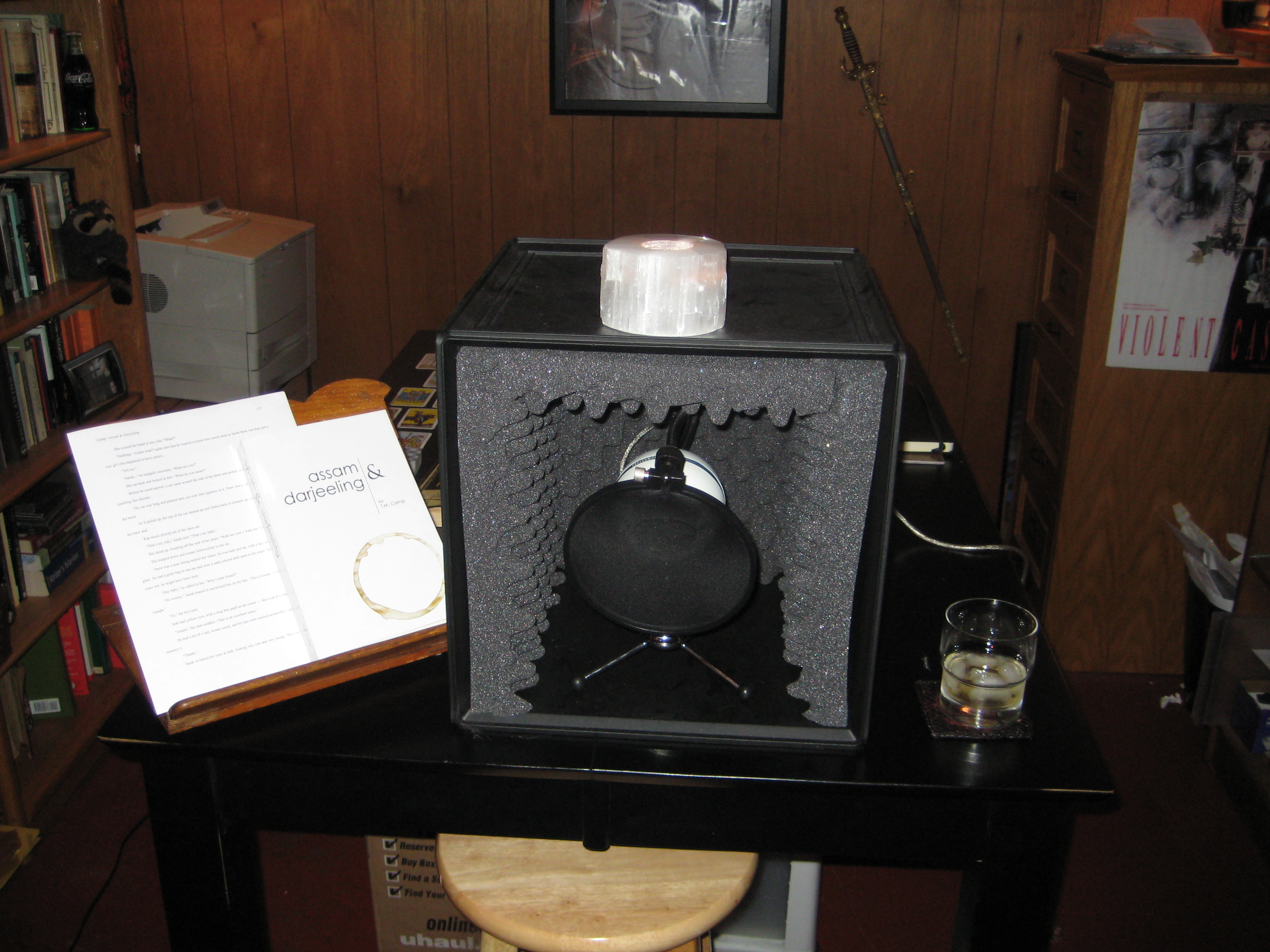
    My first recordings were done using an old Belkin mic. Eventually I rigged up a makeshift guard out of an old nylon stocking and a cunningly twisted coathanger. All of my recording was done in an open room, which is painfully obvious from the relatively low quality of the sound on my first recordings. Last year I finally got serious and bought a proper mic — a Blue Snowball and stand, with a professional pop guard. After looking around online, I built a recording box for myself using a plastic storage crate and some high density acoustic foam. The mic stays in the box and, I’m pretty happy with the quality overall. I got the idea from reading up on how reporters record voiceovers while on the road.I record in my office in the basement, so I still need to be aware of ambient noise. Most of my recording takes place when everyone’s gone or very late at night. Also, the water meter is in the corner of the room — so if anyone uses any water in the house, it sounds like a giant hamster is getting a drink. I’ve had to do a lot of retakes because of a toilet flushing somewhere.

    3. If you were able to build your dream studio, what would it include? Be as specific as you wish.
    I’m pretty happy with my setup overall. I wouldn’t might having an actual booth to record in, but that’s just a luxury. I wouldn’t mind adding another mic to the setup, though. I’m getting ready to record a few scenes from my plays, and the logistics of having another performer/reader is tougher than I expected.

    4. Other than a computer, what piece of HARDWARE would you recommend to a new podcaster?
    As I’ve discovered, a professional grade mic is crucial. And every amateur ought to build a soundproof box. The difference is so great that I’ve resigned myself to the fact that I have to go back and re-record “Assam & Darjeeling” this spring. The original just doesn’t hold up.

    5. What have you had to learn for yourself that you wish someone could have warned you about?
    Again, it’s all about the quality of the recording. I think there’s such a broad variance, that people’s standards can be pretty low. But when you hear something well done, it pushes you to want to do better. I settled for the lower hurdle early on and I regret it now.

    6. What would you consider a “beginner’s mistake” you’ve either experienced or hear others making?
    Apart from the quality issues I’ve been whining about, one of the big mistakes I made on my first podasted novel (“Assam & Darjeeling”) was separating each chapter into a separate episode. A fair number of those chapters are actually briefer than the intro/outro which is something else I plan to remedy with a new recording. No one’s really complained, but I imagine it’s irritating.

    7. How much time does it take, once you have all the elements, for YOU to put together a 30 minute podcast? (please describe your production technique)
    While I’m working on my next novel, I’m podcasting a new anthology show called “The Gospel of Thomas” which consists of different shorter pieces, mostly stories and poems that have been sitting on my hard drive or in my file cabinet for a while. It’s a way to share some of those smaller pieces that might ordinarily get lost in between the longer works.

    Each episode includes a free downloadable PDF of the text pieces from the show. So my first step in preparing a new episode is to select which piece I want to use and get it laid out and ready for the PDF. Once that’s done, I spend some time sorting through what else I want to say about the piece.

    I’ll usually run through that a few times before I’m comfortable enough to record it. I’ve got a long commute and I spend about two hours on the road every day, which gives me plenty of time to rehearse and polish what I want to say. I made a decision not to try and script anything for the intro pieces, preferring the spontaneous and natural approach.

    It’s usually on that commute that I try to nail down what I want the bumper music to be. There’s a local music group called GeniusCar that’s given me permission to use their work, which is about 15 different albums of material at this point. So I’ve got a lot of variety to work with.

    When I feel like I’ve got all the components lined up, I wait for a time when I’ll have a quiet house and get everything set up to record. The Snowball mic goes in the box and the box goes on the table in my office. I sit down in front of it and start recording. I’ll typically start and stop once or twice during a session, but I save all of it just in case I want to piece things together later. Once I’ve got the intro recorded, I move right into a reading of the story or poem for that episode. I print out the story or poem for that episode ahead of time, reading off of the paper resting on a small document stand to the left of the mic.

    Everything is organized and edited in Garage Band, with each component recorded on its own track (intro, music, story, closing). I spend a fair amount of time tweaking timing and cutting out dead air. Once I’ve got a fairly strong rough cut, I’ll leave it alone for a while. Usually this means overnight and I’ll give it a listen on the way to work the next morning. If I hear anything that needs fixing, I’ll take care of that over my lunch break so I can post everything later in the evening.

    I kick out a couple of different file formats (MV4 for iTunes and MP3 for RSS subscribers) and upload those to the server along with the PDF. I manually manage the XML file for the podcast, so I spend a little time adding a new listing and description for the latest episode. Once I get the files out there, I update the http://www.gospelofthomasonline.com website with the new listing and hit the iTunes ping address to refresh the feed.

    And then I pour myself a drink.

    But to answer your actual question, I probably spend two to three hours on every 30 minutes of finished recording.

    Casting Questions (answer if you can)

    6. As far as cast goes, what would you like to try, but haven’t so far?
    I haven’t done a casted show yet, but I’m planning to do some scenes from a few of my plays in The Gospel of Thomas. I have some opinions and ideas that i’m looking forward to trying out, but I can’t really answer these from experience at this point.

    General Questions

    1. If someone approached you with THEIR book, and asked you to podcast it for them for a fee, what would you consider a reasonable rate per episode? (The way YOU do it)
    First of all, I’d be so honored that I’d probably forget to charge them. If they insisted on payment, I’d probably ask somewhere around twenty dollars an hour. Part of that depends on how long the piece is and how much time I’d need to devote to it. It would have to be worth my while to do it, since I’d be taking time away from my own work in progress.

    2. Do you podcast as part of a larger plan, or because getting your content out in some manner IS your plan?
    I started with the “just get it out there” idea, but over time I’ve developed a formal strategic plan for sharing my work through a variety of formats/media. My approach to podcasting has evolved to fall more in line with that broader plan.

    3. What is the nicest compliment you’ve been paid or what keeps you coming back?
    I think one of the nicest things I hear is people asking where they can buy a copy of the book. That’s a real validation of all of the work I do.

    I get a handful of e-mails from listeners each month. That someone took the time to listen to the entirety of “Assam & Darjeeling” (for instance) and then took the time to let me know how much they liked it, that makes my day.

    4. How important are numbers of downloads/subscribers to you? Do you keep track?
    I use Feedburner to monitor the activity. It’s hard to know how accurate those numbers are, but I try not to read too much into them. I think that it’s easy to make stats the only measurement of success, putting quantity over quality.

    5. How important are reviews left on Podiobooks/iTunes/other venues to you?
    Again, I really appreciate that someone took the time to listen and then went that extra steps to review or rate it as well. Even if they don’t express undying love and devotion for my creative genius, I always appreciate them circling back to participate in the process as a reader. I think it’s great.

    6. If not answered previously, how do you read your manuscript while recording (hard copy, teleprompter, etc)?
    For “The Gospel of Thomas” I rely on a hardcopy, but that’s a pretty short format. For the novels, I open up the document and read it off of the screen. One of the big discoveries I made getting “Assam & Darjeeling” ready for printing/publishing was that I’d broken up the text a great deal during the recording process — which made it optimized for reading aloud but rather difficult and disjointed to read on the printed page. I ended up having to tighten everything up again in the final draft.

  • Jeffrey Hite is the creative genius behind the weekly Great Hites story contest. He is also a frequent contributor and an encourager of writing at all levels.

    General Writing Questions

    1. Before you begin writing, do you script out the general outline of plot and characters, or do you let these situations evolve as you write?
    I used to try to outline or script, but my work always ended up being too stilted.  I have found that my best writing is when I  let things to flow as free as possible.  Most of the time when I start a story I have no idea where it will end up, even when I do have an idea about where it will go, it does not end up there.

    2. I’ve heard repetitively that writers should deal with writing as any other job. Do you have a scheduled or structured writing routine? Please detail.
    I don’t know that I have what it would take to be a professional writer, not that I don’t want to be just that I don’t.  I write 3/6 times a week, I try to write for a an hour or so at a time.  When I do write, again it is best not to have aplan about what I am going to write.  Some times I just play with ideas until one strikes my fancy.   My normal time to write is over lunch time, for hour I have for lunch.

    3. What is your writing environment like? (cats, music, computer etc.) How has this evolved/changed?
    My writing environment is as chaotic as my writing style.  I like to listen to music but some times is distracts me.  We have a couple of couches at work that were left over from the former owners and if I write during lunch, I usually sit there.  If I am able to write a home, I write usually at the kitchen counter.  I do occasionally hand write stories but, my hand writing is so bad i often have a hard time reading it, so although I like the feel of pen on paper, I don’t do that all that often.  the long end short of this is that I write when ever I have a moment and in whatever form I have available to me.  I have even written a few stories on my ipod.

    4. Do you write anything, or have you, that is solely for yourself? (no intention of sharing with a large audience)
    I don’t keep a journal or anything like that.  I have kept travel diary that I only planned on sharing with my wife and kids, but no I don’t write things just for me.  I look at the whole writing experience as for me, as I do it because I need to / have to other wise the stories in my head would drive me nuts.

    5. How has social media played a role in your writing?
    Socical media has given me an outlet for my writing that I didn’t have before.  I feel good sharing my work with people, and I think that is the one thing that has helped me the most.  Even if my writing only reaches a few people, they are people that would have have read it before, and hopefully some one likes it

    Podcasting Questions

    1. What type of OS do you prefer? Linux? Mac? Win? What are your machine’s specs?
    This is a more difficutl question that is sounds like.  I am not a windows fan but, my knowledge of Windows pays the bills so I guess I like it in that way.  But for podcasting it is a MAC, macbook (white) (a couple of years old now.)  My web server and my data server / backup webserver / and fire wall are all linux, Fedora core all the way man.

    2. Would you please describe your current studio? How has this changed? (What did you start with?)
    Studio?!?! My office (the little room that holds the servers is where I do most of my recording, but I will record wherever I can find a quiet spot.   I started recording in the front seat of my car, moved to a  small room at the office, then moved to my wife’s closet, but when I came back from y last business trip I found that my recording would wake the baby so I have moved to my office.  I shut down the loudest of the servers and play with the mic unit it can’t “hear” them.

    3. If you were able to build your dream studio, what would it include? Be as specific as you wish.
    I am too much of a geek for this question.  I would want all the best, sound proof walls, a lacky to run some sort of mixing board and check levels and wonderful microphones.

    4. Other than a computer, what piece of HARDWARE would you recommend to a new podcaster?
    A decent Mic.  You can’t go wrong with buying a nice mic to help you with your sounds quality.  I have had a couple, but each time I upgraded I wondered how I tolerated the last one I had.

    5. What have you had to learn for yourself that you wish someone could have warned you about?
    How to use the filtering software.  I had to play with so many of the settings and experiment with them with figure out what sounded best for quality.  I wish I could have sat down with someone to show me what each of the setting did and have them explain to me which ones were good for me and which one would hurt my quality.

    6. What would you consider a “beginner’s mistake” you’ve either experienced or hear others making?
    I feel like I am too much of a beginner to make a comment about this one, remove the log from your own eye before remove the splinter from your neighbors.

    7. How much time does it take, once you have all the elements, for YOU to put together a 30 minute podcast? (please describe your production technique)
    My podcast requires that I listen to three or four stories, when decided how they should go together.  That usually takes a hour or so.  Then I put them all together and record intro for the podcast (yup different for each one) and intro for each story, my reaction to each of them and then an outtro for the whole podcast.  Total time, for a 30-40 minute podcast probably 3 to 4 hours.

    Casting Questions (answer if you can)

    1-4 No Answers

    5. What is the hardest part of putting together a “straight read” podcast?
    I read like a third grader.  I usually read the story three or four times to myself before I read it to record, and it still sounds like I don’t know how to read.  So the short answers is editing my own reading.

    6. As far as cast goes, what would you like to try, but haven’t so far?
    Not answered

    General Questions

    1. If someone approached you with THEIR book, and asked you to podcast it for them for a fee, what would you consider a reasonable rate per episode? (The way YOU do it)
    Would I do it. Yes, I don’t know what a good rate is.

    2. Do you podcast as part of a larger plan, or because getting your content out in some manner IS your plan?
    That is my larger plan, just getting people to see what I have written, I don’t care if I get paid for it.

    3. What is the nicest compliment you’ve been paid or what keeps you coming back?
    That Great Hites was someones EscapePod replacement. [Editorial note… I seem to remember that comment being made on Twitter]

    4. How important are numbers of downloads/subscribers to you? Do you keep track?
    I keep track, and them mean something to me, but I am not sure what.  Obviously the larger the numbers the better, but honestly I think it bigger numbers make me happier for the other writers than for myself.

    5. How important are reviews left on Podiobooks/iTunes/other venues to you?
    I like them, but since my podcast is about writing practice and other peoples writing I find that constructive feed back is more important.

    6. If not answered previously, how do you read your manuscript while recording (hard copy, teleprompter, etc)?
    I have tried reading on my computer screen, on paper and on my iPod.  I think right now I like reading it from my ipod best because it makes so little noise.

  • Born during the witching hour within hours of the winter solstice, Paul Elard Cooley has been writing and slamming down keys on a computer since the ripe old age of 12. He has seen more than his share of bad horror movies, read more than his share of great horror novels, and generally learned to loathe humankind (unless they’re his fans). When he’s not writing, tweeting, or podcasting, he’s usually developing enterprise software for companies that lay him off all too often. At present, his job title reads “professional horror hack” and job description includes “other duties as assigned.”

    Paul is the author of the Fiends collection, Tattoo, and his newest novel, “Closet Treats.” All his work is available at Shadowpublications.com, iTunes, and Podiobooks.com.

    General Writing Questions

    1, Before you begin writing, do you script out the general outline of plot and characters or do you let these situations evolve as you write?
    Writing for me is usually a bit of a discovery exercise. I get an idea for a story, but usually it’s just a kernel, a nugget of an idea. The story itself has to be teased out from my brain until I have enough information to really begin working on the rest of the tale. But once I get about 10k -20k words in, I have to start outlining on the longer works. In order to properly get the plot working and the characters, it takes a full outline which I then may or may not follow. Books are more difficult than short stories. Short stories happen fast and usually without too much effort. But novellas and novels are more involved. Much more involved.

    2. I’ve heard repetitively that writers should deal with writing as any other job. Do you have a scheduled or structured writing routine? Please detail.
    I try and write in the morning. When I wake up, I have 3-4 hours before my brain wakes up and decides it wants to get logical. Once that time in the morning disappears, writing can take an awful lot of work. It doesn’t flow very well and can be very frustrating. There are times, of course, when this is not the case. Basically, I try and write at least 1k words every day. But that has to be tempered by the other insanity in my life (of which there’s been a lot lately).

    3. What is your writing environment like? How has it evolved and changed?
    I can’t write without music. Usually serious industrial, metal, techno. Something with a nasty horrid beat and lyrics that make virgins blush and the religious run to their churches. I use two screens, one for writing, and the other for a browser when research is necessary. I write using xemacs in the console mode or Scrivener in full screen mode. Both have black background with green text. I try and hide the rest of the OS and all other applications at all times. This helps a lot.

    My fuzzies (two cats and a HUGE dog) usually keep me company. At least one of the cats ends up in my lap at some point in the day. It’s just the way it happens. Since I started writing again, things are pretty much the way they started, only that since my Linux box died, I’m a mac-only person now.

    4. Do you write anything, or have you, that is solely for yourself?
    There are many stories I’ve written (not finished) that started out only for myself, but ultimately needed to be released for some of the series I’m working. I’m afraid to admit it, but I’m a bit shy when it comes to writing about sex, but some of the stories I want to write, I’m going to have to really delve into that subject. I haven’t shared them yet, but they’re in the near future. And although those stories start out just for me, they’re all going to end up out there in the ether. At least the ones I can finish.


    5. How has social media played a role in your writing?
    Social media is a huge time sink. If I’m not careful, I end up spending all frackin day on twitter and facebook. Really have to struggle to keep that from becoming my day. However, it does sometimes pay off. My novella, Tattoo, only exists because one of my listeners, Pons Matal, told me about something he’d read. Canvas, one of my short stories, caused him to relate this incident and that ended up giving me my most popular work.

    Also, social media has kept me writing. Most people are shy about leaving comments in the forums, but they do send me DMs or messages via Twitter to tell me what they think. That kind of support is difficult to replicate without social media. I have to say that during my most vulnerable moments, when uncertainty and doubt creeps in, the social media aspects have managed to keep me going.

    Podcasting Questions

    1. What type of OS do you prefer? Linux? Mac? Windows? What are your Machine’s specs?

    I use a little Mac-Mini to do everything now. I used to write on my linux box, and podcast with the mac mini. But as of now, I only use the Mac. It only has 2gigs of ram and is the older 2ghz model. Basically, it’s a hamster computer. But it does what I need to do…for now.

    2. Would you please describe your current studio? How has this changed? (What did you start with?)My studio has always had:a: Behringer XENYX 1204

    b: AKG Perception 220

    c: 15 year old pair of Sony Studio Mixing Headphones.

    My setup cost me about $200.00 all told and has been worth every damned penny.

    3. What would your dream studio look like?
    Oh, for the want of some serious cash.

    The only things I would change:

    a. soundproofed room. I MEAN SOUNDPROOFED!

    b. Mac Pro with lots of RAM and SERIOUS firepower under the hood for crunching and editing audio

    c. Logic Pro for editing and mixing.

    d. new set of studio headphones (LOL)

    e. better mic boom

    4. Other than a computer, what piece of hardware would you recommend to a new podcaster?
    The BEST Mic you can get your hands on. My AKG Perception 220 condensor mic gives me a MUCH better voice than I deserve. It warms it and makes me sound somewhat like a pro. But it’s VERY sensitive. But while you can use Audacity and GarageBand and god only knows what else for recording and mixing, you can’t fix a shitty mic. So make sure that’s what you aim to ultimately have.

    But if you can’t afford a damned good mic, Invest in a ZOOM H2 for podcasting. It’s a good enough mic and is self contained so you don’t even need a hardware mixer. I’ve used it for a couple of “mobile” casts now and I’m very happy with it. Although it will never replace my AKG mic.

    5. What have you had to learn for yourself that you wish someone could have warned you about?
    I think I was actually warned pretty well, LOL. After listening to Scott Sigler and others talk about how much work it was to do this, I was well prepared. If anything, I wish someone would have warned me about just how much work it takes to edit and make an episode sound professional. I never would have guessed it could take a freakin’ hour to record ten minutes of audio, mix it, and then send it to the internet. Sometimes it’s daunting just how much of your life can be spent getting one freakin’ paragraph sounding better than shit.

    6. What would you consider a ‘beginner’s mistake’ you’ve either experienced or hear others making?
    a) I’ve listened to many podcasts that sound like they’re recorded inside of a tin can while a garbage disposal of static fills the background. This makes it very difficult to concentrate on the words and such. Also, and I was guilty of this too, being too lazy and repeat a phrase that you stumbled on. This can really break the flow of the story. It’s not a good practice to get into.

    b) For god’s sake, do not read your work off of paper! No matter how hard you try, you’re going to have to get the shuffling, crinkling of paper out of your cast. Either invest in a damned lectern, or read it off the computer. There’s no damned reason to watch your audio record, so read it off the damned screen. Crinkling, shuffling paper sounds very unprofessional and is the sign of someone who hasn’t really thought about what they’re doing.

    7. How much time does it take, once you have all the elements, for YOU to put together a 30 minute podcast. please describe your production technique.
    A 30 minute podcast. Ugh. Okay, so here’s what I do for an episode of Closet Treats:

    a. Record a chapter as its own file (3-15 minutes + time for repeats [this can take 45 minutes if I really suck that day]).

    b. Edit the individual file and make sure it sounds good. This requires listening to the entire chapter.

    c. Export the file out as a VERY high quality AAC file.

    d. repeat a-c until I have all the chapters done for the episode.

    e. Create a new garageband project. Put in the “intro.” Bring in each individual file into the new project. Add chapter breaks (“Chapter X”) and transition sounds. Add outro music.

    f. QC entire episode to ensure I didn’t miss anything in the “a-c” section.

    g. Export file to AAC high quality

    h. Use levelator on entire episode.

    i. Edit ID3 Tags.

    j. Put on the web.

    So a 30 minute podcast? It can take HOURS. It depends on how many chapters there are and how much I SUCK at reading that day. But I’ve gotten the rest of it down to a pretty good flow. It took a long time to get into the routine, but every episode gets easier. You can’t make audio crunch faster (without a faster machine). More importantly, you can’t rush the QC portions. However long it takes, is however long it takes. There’s no way around it.

    Casting Questions

    1. What is the hardest part of putting together a casted podcast?
    Up to this point, I’ve only ever had one other performer in my works. But this is a serious freakin’ pain in the ass. They record their lines, and then you have to chop up your reading, insert/edit their audio files to fit. It can be a very very long process whereby a simple 3 minute conversation takes an hour to edit. There’s a reason I don’t do this very often. It can make for a great audio drama, but it keeps you from writing. And that’s always a BAD thing.

    2. Do you provide the entire chapter to your talent, or just their lines?
    Talent gets the entire story or entire chapter. I think it’s important that the other actors know the context of their lines. Otherwise, it can get very difficult for them to figure out their character.

    3. Is instruction given to your talent on how you prefer the line to be read?
    I’ve been blessed on this. Working with Andrew Richardson, I simply gave him the idea, a little bit of an idea, about how I saw the character. He read Nigel from Tattoo in a way I’d never even dreamed. It turned out better than I’d expected and made the character one of my favorites. It’s difficult to direct someone from miles and miles away. And without being there live to help them figure out the line, it could take DAYS to get the audio you want. So I try not to be a fascist director. I don’t think it’s helpful and I certainly don’t have time for it. I like to let people use their imaginations and bring to the production exactly how they see the character.

    4. What do you do with all of that unused audio?
    Unused audio? I FLUSH IT! I’ve often thought of making a blooper reel, but the majority of my f ups end up going to data heaven.

    5. What is the hardest part of putting together a “straight read” podcast?
    A straight read podcast requires you to make a decision: come up with your own voices for each character, and figure out how to make the changes between voices enough for the reader to grab it. I don’t go as crazy as Scott Sigler, but I try and give each character their own voice. Female voices ARE THE WORST! I don’t do them very well and enunciation is VERY difficult.

    6. As far as cast goes, what would you like to try, but haven’t so far?
    Next year, when I tackle “The Day The Town Died”, I’m going to have to have at least 4 voice actors. That is going to be hell, but it’s the only way I can properly do the cast. So, I guess that’s going to be the “I haven’t done this yet” but doesn’t fall into the “I want to do this” category. 🙂

    General Questions

    1. If Someone approached you with THEIR book, and asked you to podcast it for them for a fee, what would you consider a reasonable rate per episode? (The way YOU do it?)
    Eek. This is difficult Guess it would depend on how many voices and etc. But IF I was going to charge for this, I think $30 an episode is fair. Yeah, I’m cheap.

    2. Do you podcast as part of a larger plan, or because getting your content out in some manner IS your plan?
    I podcast because I love doing it. But also, yes, it is part of the larger plan. I’m building a fan base. I’m starting a business. I’m becoming a professional writer. And without an audience, there’s very little reason for me to keep writing. Without an audience, there is no feedback. Without podcasting, there is no audience.

    3. What is the nicest compliment you’ve been paid or what keeps you coming back?
    “I just listened to one of your essays. You made of brilliance.”

    “I finished an episode last night and couldn’t sleep. When’s the next one coming out?”

    “Can you please give two episodes a week? I can’t wait an entire week for the next one!”

    “You scared the hell out of me.”

    Comments about how good my writing is and how much they enjoy the characters come rather infrequently, but they definitely keep me writing and podcasting. I love what I do. Hearing from people who are enjoying it make all the expense in both time and money worth it.

    4. How important are numbers of downloads/subscribers to you? Do you keep track?
    I have obsessive compulsive disorder when it comes to watching subscriptions and download numbers. I check them at least 5 times a day: I can’t stop myself. Sometimes it can be a little depressing because I want instant gratification: 200+ downloads the first day, for instance. But I’m getting used to it taking a while. A lot of my listeners are on very different schedules and like to pile up a whole bunch of episodes before they download them. I understand this behavior. But it’s taken me a long time to get used to it. A LONG time.

    5. How important are reviews left on Podiobooks/iTunes/other venues to you?
    Comments and reviews are awesome. They’re great. But I know how fickle people can be. When I see some great reviews, I usually know the person already from Twitter or Facebook. I see their username and know instantly who it is. Tattoo has a review on iTunes from someone I’ve never heard of before, and what they said means a lot to me. Seeing 5 stars on iTunes for your cast and your stories is great, but when there’s only ten reviews or so, it seems a bit…well…false. But they’re important because they might be the thing that brings another potential listener or fan to the cast. Therefore, they are very important. But I’m a realist. I’m not in the big leagues. I’m not a JC Hutchins, Scott Sigler, Philippa Ballantine, or Phil Rossi. It’s going to take a long time for me to build that kind of audience and therefore, I have to be patient. It will come. And I’ll just keep writing and trying to get better with every episode.

    6. If not answered before, how do you read your manuscript while recording?
    I said before, I always read it on the computer. A long time ago, I tried using hardcopy, but, man, it sucks. I hate it. It doesn’t work for me. So the computer is the only way I do it now.

  • P.C. Haring is the author and creator of Cybrosis, a cyberpunk action thriller starring many of the big names in podcasting today. He lives in Naperville, Illinois and besides being a writer is an accomplished musician with his primary instrument being the viola. And this is how he does it.

    General Writing Questions

    1, Before you begin writing, do you script out the general outline of plot and characters or do you let these situations evolve as you write?
    The quick answer is ‘Yes” When I first started working on Cybrosis, the outline was very much an exercise in “what happens next” . I wrote chapter 1, asked “What happens next” and the answer became chapter 2. Rinse wash repeat. It wasn’t until I got into the last five chapters of Cybrosis that I actually started to sit down and plan out the rest of the book This is not a method to which I intend to return.

    For all my writing since Cybrosis, I figure out what kind of story I want to tell and then go about building a world which will allow me to tell that story. I keep the world building fairly basic. Characters, settings, locations, technologies, major historical events, etc. Once I have enough of a grip on it in my head, I’ll then go and start outlining. I tend to outline only a few chapters ahead of where I’m writing. This gives me the structure to know where I’m going and the points I want to hit, but at the same time the lack of a full outline, leaves me the freedom to let the story evolve and grow without my worrying about straying too far from the outline and having to go and re-do it all.

    2. I’ve heard repetitively that writers should deal with writing as any other job. Do you have a scheduled or structured writing routine? Please detail.
    Ideally, yes I do. I try to write at least 1,000 words per day as a rule. This hasn’t been happening recently as personal issues have been demanding a lot of my time, but I plan to get back on that schedule this summer. I’m fortunate enough to have two very understanding supervisors at my day job who are very supportive of my writing. With that in mind, during the week I can be most prolific during my lunch hour at the office. On the average day, I can write 600-800 words in that hour, though my personal best for any given lunch hour is sitting around 1700. Once things settle down this spring, I do plan to re-evaluate my routine and see how I can make it better than it presently is.

    3. What is your writing environment like? How has it evolved and changed?
    I can’t write in a silent box, but like most others if there’s too much distraction, I also can’t write. Writing in my office is actually pretty good on its own. There’s enough activity to keep me from going nuts, but usually not so much activity I can’t concentrate. When I’m at home and writing, I try to reduce visual distractions. I turn off the television, skype, twitter, other social media networks. I usually add music from a dedicated “writing” playlist to the mix and listen to it at a reasonable level either through my computer speakers at home, or on my earbuds when I’m on my laptop at work or elsewhere. It really hasn’t evolved or changed all that much over the years. That said, one of the things happening this spring is I’m moving to a new place, so I’ll be interested to see how things evolve when I get settled in.

    4. Do you write anything, or have you, that is solely for yourself?
    Typically, I do not. Putting fiction aside, I have been known to write very blunt, aggressive rants directed towards specific people and circumstances. When I do that I usually share them with at least one other person, a friend or family member as that sharing helps me to release frustration over an event I can not control.

    That said, there are two scenes in my current draft novel that I wrote but have no intention of sharing. The first scene was one I’d written to get a series of mental images out of my head. It was fully tangental to the plot or the point, and it was not a scene I felt belonged. I wrote it to excise it from my brain so my mind could focus on other things. Two minutes after I finished writing the scene, I deleted it. It was very therapeutic.

    The second scene I wrote that I will not share was written as an extension to a scene that remains in the draft. I did this primarily for consistency sake. In terms of the narration, there is an event that occurs, but the motives for that event are not what they seem to be on the surface. The public draft will see that scene end and cut away about halfway through the content I’d written. This is to build suspense and to give me the opportunity to litter in our characters reactions to what the reader will NOT see as I continue the story. Ultimately the reader will know what happened in that second half, but they will NOT see it verbatim. Yet I felt the need to write it so I could get into my characters heads, and know for certain what was and was not said and done for when it comes back to haunt them.

    5. How has social media played a role in your writing?
    I could spend 10,000 words on that answer alone. Social media has exposed me to many other authors, most of whom are in the same boat I’m in right now. I have relationships with other authors I would never have dreamed of in the past. The support network we’ve developed, not just from writer to writer or podcaster to podcaster, but writer to listener and listener to listener, is quickly becoming invaluable as it’s given me a much larger pool of talent and perspective I can work with and draw from. Whether I’m podcasting a full novel, or sending an excerpt of a new draft to a friend, or reviewing the same from another, social media is, in part a writers workshop that’s always open where the attendees are always revolving so the perspectives change, and I couldn’t be happier for it.

    Podcasting Questions

    1. What type of OS do you prefer? Linux? Mac? Windows? What are your Machine’s specs?
    Hands down I prefer Mac OS X in any of it’s versions. In the three years I’ve been on the Mac side of computing, the hardware and software has proven itself far more stable and reliable for my needs than windows and Microsoft have over the previous decade. My primary production machine is an Apple Mac Mini on a 1.83 Gig Intel Core Duo processor with 2 gigs of RAM

    2. Would you please describe your current studio? How has this changed? (What did you start with?)
    Interesting question since Off the Deep End Studios is presently in a state of pending transition. Cybrosis was recorded my current configuration; a ‘den’ in my soon to be previous apartment. It’s large enough to support my desk, recording equipment, office drawers, a few book shelves and still have some room to spare. It’s a very boxy, very live space that’s made recording a challenge, one I’m not sure I’ve successfully met. My first recording environment (I won’t even call it a studio) was very much dormitory room style. Wherein my bedroom, studio, office were all in the same room. That was a far smaller set up with just a basic logitec USB microphone plugged directly into the computer itself.

    3. What would your dream studio look like?
    It’s funny. I started writing the response and the more I thought about it, the more my opinion changed. A little bit of context, because I’m in the process of moving, I’ll be re-designing Off The Deep End Studio. In it’s current conception, OTDES 2.0 will be created from a converted clothes closet (non walk in). I’ll be putting up studio foam along the back wall, sides, and maybe I will extend the side walls into the room a little with a piece of removable plywood or two to help create that recording booth feel. I’ll also be adding a second microphone, designed for instrumental recording.

    At this point, this is as close to my ideal setup as I can envision. The only other change I would prefer would be to make the closet instead of the nook in the wall design with folding/sliding doors, to make it a full walk in that I could set up and then go in and close a door with the computers and everything else outside.

    4. Other than a computer, what piece of hardware would you recommend to a new podcaster?
    I know there are podcasters who will disagree with me, but my first recommendation would be a decent microphone. It’s a tough thing to select a microphone. There are so many varieties out there with varying price ranges, options, bells and whistles. But at it’s core all microphones are the same -they they detect sound waves and transmit them to a recording device. Different microphones will make a user sound different even if all other variables are consistent. So it’s important to find one that makes a podcaster sound the way that podcaster wants to sound.

    I’ve yet to find a “try it before you buy it” program from reputable dealers of microphones, but if you can find one I’d highly encourage it. Contact the podcasters you listen to and find out their recommendations. If you can, borrow microphones and test them to see how you like working with the unit. There are a lot of good options out there whether you are looking for a studio Mic that requires a mixer or pre-amp, or just want to pick up an easy USB plug and play microphone. These options don’t have to break the bank either. The microphone I use sells for between $100 and $150 so while it is a little more expensive than you might like to spend, one needs not spend $700 for a mic, either.

    5. What have you had to learn for yourself that you wish someone could have warned you about?
    Narrative delivery and the ‘dramatic read’ In truth, I actually did receive a couple of warnings about this walking into Cybrosis, but it’s not a lesson that can just be taught like the next math problem, but rather something the podcaster has to develop on his/her own. The initial tendency, when reading from copy is to read too fast. I know my words and I’m trying to narrate a story and pull the reader into my world. But at the same time if I move too fast I’ll lose my listener. On the flip side, if I move to slow, I’ll fark up the pacing. It’s like that high school or college professor you had…we’ve all had one of these…who just stands up at the podium for the entire hour and begins his lecture and doesn’t stop speaking even long enough to take a breath before they move on to the next topic and it’s just like this for the entire hour as the prof drones on and on and on and you are trying your hardest just to stay awake to say nothing about actually comprehending or absorbing the content they’re trying to teach.

    So the trick is the dynamic read — Finding the proper tone of voice, the proper emphasis in the appropriate areas of the prose to deliver emotion without shouting into the mic, too slow down and speak a little more wistfully as the character recalls a pleasant childhood memory, but then to drive aggression and anger over the betrayal of their closest confidant all while not going so far over the top that you blow the listener away while you make sure the delivery is clear enough to be understood so the listener isn’t left questioning (or re-winding and re-listening), thus destroying the emotional aspect and the pacing. It’s a fine balance and one that every podcaster is constantly struggling. Developing this is not a learned skill so much as an art that continually evolves grows and changes.

    6. What would you consider a ‘beginner’s mistake’ you’ve either experienced or hear others making?
    I would have to say that the biggest beginner mistake I’ve seen has been starting before the production is ready. I can’t tell you how many podcasts I’ve listened to where one or two or three episodes have come out like clockwork only to have the production mired by delays, infrequent releases, and a general concern of whether the product is podfading. I believe this is because producers did not properly anticipate the demands on their time when they got their project started and/or underestimated their buffer. You’ll hear a lot of podcasters talk about a ‘buffer’ that fun ‘head start’ between the next episode of the podcast that goes live, and the number of shows after that you’ve got in the can. I’ve asked, been asked, and heard others ask “how many show do I need to have ready to go before I start?” Some people say five, others say ten, others say half. But I’ve come to realize that there’s no rule. But there may be a formula and I’ll use Cybrosis as an example as I walk through the way to figure it out—

    How many episodes is your podcast novel going to be? 20.
    How often will you release an episode? Weekly
    Duration of the podcast — 20 weeks.

    How long does it take you (on average) to produce an episode — 2 weeks.
    Total production time 20 episodes * 2 weeks per episode. 40 weeks.

    So with that in mind, if I plan to have ten episodes of the podcast ready to go before Episode 1 goes live, I should be able to complete the 20th just in time for it to go live, and do so without significant production delay. There are of course other factors to consider — Do you want to maintain a buffer of X episodes throughout? Are there big things coming up in your life that would delay your ability to produce? Are you going to have music elements added by a composer who needs time to work with your audio before the music can be written? Are you comfortable with delaying an episode a week or more if need be? It’s very easy to bite off more than you can chew in these projects, but a little bit of pre-planning, (sure we can call it being anal), can save a LOT of stress once that first episode goes live.

    7. How much time does it take, once you have all the elements, for YOU to put together a 30 minute podcast. please describe your production technique.

    Once I have all of the raw audio back from my voice actors and my narration recorded, it can take me anywhere between 3 and 8 hours to cut it all together and make it ready for the episode. I’m sorry I don’t have a more precise measurement, but there are a lot of variables in my production.

    Once I have all the elements I’ll sit down with the script and press play on the audio project file. I let my narration run until either I screw it up, re-take it, or a line of dialogue is needed. When other dialogue is needed I’ll bring in their audio at that point, and begin the same process on a different track and I keep going through that process of listening to the line, pulling out the flubs, and the extra unused takes, cutting and timing together as appropriate. But as I said, there are a lot of variables— what is the quality of my narration? If I have two pages of solid prose and I have to re-take every paragraph four times for whatever reason, it eats more time to listen and screen takes out than it would if I was able to knock out the entire passage in just two takes. How many voice actors do I have to consider, and how many of them appear in the same scenes? I had once scene between 4 people in one of my early chapters. IT was a 2 minute scene that literally took me an hour and a half to pull together as I was listening to multiple takes on the same lines from multiple actors. Then I had to go back in and listen to the selected takes to see if the tone and delivery from one to the next seemed to flow in terms of a conversation that would be taking place were those 4 actors all in the same room and just chatting it up. But at the same time, one of the final chapters in Cybrosis, is primarily action. It’s 90% prose and narration and what little dialogue there is, is mostly one liners and quick comments that don’t require the feel of a flowing conversation that chapter ended up being 20-30 minutes of content, and took me two and a half hours to complete.

    Once the voice work is cut together and the extraneous is removed from the project, I then go about scoring for a sound track. This is the other wild card in terms of time. Usually I get an idea of which moments I want to have music underscore and what, In general, I want that music to sound like. My primary resources have been digital juice and the mevio music alley though I do also collaborate with other composers if things work out. Listening to and screening music clips can be very time consuming. I usually can tell within the first 30 seconds to a minute of a clip, whether or not I think it’ll work for the specific moment I need. Digital Juice clips also have some additional customization options that I’ll tweak if needed. But after I’ve selected the cut, it’s just a matter of importing the file into the main project, and balancing it under the dialogue.

    Once the music is done I declare the chapter ‘done’, save it and export it. That’s the end of my 3-8 hour estimate.

    I’ll listen to it in the intervening weeks. Then, a few days before that chapter goes live, I mix the chapter into the episode which is where I insert the credits, the theme music, the story so far, the promo, and any announcements I make. Usually this final step takes me an hour depending on how long it takes me to record and edit my announcement segments.

    Casting Questions

    1. What is the hardest part of putting together a casted podcast?
    Being cognizant of the fact that your cast has a life outside of your production. Deadlines are great and usually tend to work well. But we’re all human beings here and sometimes daily life means that the cast has to blow your deadline in order to tend to more pressing needs. This goes back to my comments about the buffer. I can ask my cast for a 2 week turnaround on a chapter, but if something happens and they end up taking 3 weeks or even a month…that needs to be a consideration. And sure, you can still cut a chapter together without an actor’s content and use temporary ‘proxy’ lines to leave the gaps needed and just slot their lines in later. But every voice is different, every person has their own unique pace and rhythm and every time I’ve subbed in my voice for a missing actor, there have been timing problems when I went back to put in the actors voice. The trick here is patience and open communication.

    2. Do you provide the entire chapter to your talent, or just their lines?
    Actually, I did one better than that. For my primary character actors, I provided them the entire manuscript, even if some of them were only in a quarter of the book. I did this for two reasons. First, to thank them for participating, and second so that if they wanted to read the book, and know what was going on during the intervening chapters where their character wasn’t present, but will have to react to in later chapters, they could.

    When I delivered scripts to the actors, they got the entire chapter, even if they only had one or two lines in it. Again, this was so they’d have the bigger picture and be able to read the lines before and after to see what they’d be reacting to and so they’d have the prose that describes the way the line is delivered. In audio hearing me say “Ciris hesitated” followed by Ciris’s line doesn’t work. It pulls the listener out of the world. But if Heather reads in the script that Ciris hesitates, she can then deliver the line with a stuttering “I” or the sound of hesitation in her voice. If it’s an interrogation scene and the character is circling the table, it helps the actor to know what the character is doing as the line is being delivered.

    3. Is instruction given to your talent on how you prefer the line to be read?
    Absolutely. But in the grand tradition of Pirates of the Caribbean “they’re more like guidelines, really”

    I use Word’s comment feature to highlight specific lines and leave specific notes. Whether they be to emphasize certain words or phrases, or things I see in my mind. I’ve also been known to give my talent some insight on what’s going on behind the scenes that the character would know about but the reader wouldn’t quite yet. For the most part, the voice actors have been receptive and appreciative for the notes.

    4. What do you do with all of that unused audio?
    It depends. If an actor has delivered a humorous out-take, I’ll spin it into it’s own track and save them for potential usage in a gag reel. If the unused audio is merely just another shot at a line that I didn’t select for whatever reason, I usually delete it from the project file. Removing the extraneous audio helps keep the file ‘cleaner’ and easier to work with. It also keeps the size of the file down as well. I keep all of the raw audio the actors give me in their original audio files so if I ever need to go back and reference something, I have the original source data available to me.

    5. What is the hardest part of putting together a “straight read” podcast?
    I did a ‘straight read’ for a short story about a year or so back. For me the hardest part was trying to differentiate the voices of the speakers. I’m not much of a voice actor and the piece in question called for me to approximate the voice of a young girl. I was…under impressed…by my results.

    6. As far as cast goes, what would you like to try, but haven’t so far?
    It’s hard to say. The production of Cybrosis required me to do a lot with vocal filters, transformations, and other post production effects and some of the future projects in my mind are going to require some different elements that I’ve not tried yet. I don’t want to speculate on what production needs I might have for my cast, but I’m looking forward to the challenge.

    General Questions

    1. If Someone approached you with THEIR book, and asked you to podcast it for them for a fee, what would you consider a reasonable rate per episode? (The way YOU do it?)
    It’s hard to say and I don’t honestly know for sure. It would have to depend on what the project was, how long it was, whether the author wanted to do a full voice cast or wanted just a straight read and what the production requirements would be.

    2. Do you podcast as part of a larger plan, or because getting your content out in some manner IS your plan?

    A little bit of both to be honest. I’m hoping that podcasting my work will help me find an audience and a bit of a following. There is a part of me that would like to see success with the podcast turn into success with a print run of my work. But, speaking from a stand point of pure statistics, it’s highly unlikely that Cybrosis or any of my other projects will see anything more than a slush pile in a professional market and if someone gets into podcasting their novels for the sole purpose of turing it into a print contract, I argue they’re doing it for the wrong reasons. Don’t get me wrong, as I said there’s a part of me who would love to have a print contract. But more than that, I’m very happy to have a wonderful audience of people who have found and enjoy my work. As a story teller it is my job to not only create stories, but more importantly, also to share them with others. Already I’ve succeeded in this with the podcast and I couldn’t be happier.

    3. What is the nicest compliment you’ve been paid or what keeps you coming back?
    I’ve received a lot of compliments since Cybrosis went live and many of them have amazed and surprised me. But I recently received a review where the reviewer suggested I might one day evolve into one of the greats. This coupled with another with a similar review about becoming a ‘household name in podcasting’, just blew me away. It’s these kinds of reviews that keep me coming back. It’s one thing for my family and friends to tell me they like what I’m doing when I ask them their opinion. But for a listener, who I don’t know and doesn’t know me beyond the podcast itself, to take the time and leave comments is a very validating experience.

    4. How important are numbers of downloads/subscribers to you? Do you keep track?
    I do keep track of subscribers and content downloads, but I do try to keep it in perspective and not place excessive importance on the numbers at this stage of the game. I don’t have an agent looking for numbers so they can pitch that to publishers. I don’t answer to anyone with my writing other than myself and my listeners. So while I do track it, I also try not to live and die by those numbers. I podcast to share stories and I believe that if I continue to do my thing, tell my stories, promote myself and my work, the audience will grow.

    5. How important are reviews left on Podiobooks/iTunes/other venues to you?
    Extremely important. If I don’t hear feedback from my audience, I have no way of knowing whether my writing is working for them. I have no way of knowing if that scene I was worried about works or not. I am very happy and eager to receive all constructive feedback, regardless of how critical they may be and I try to respond to all of it, even if not directly. The positive reviews help bolster my ego and give me an excuse to puff up my chest with pride. The negative or more critical reviews are just as helpful and give me something to respond and react to. As a content creator, I have neither the luxury nor the desire to directly debate with everyone who dislikes my work. But if their comments are constructive and have valid points to them, those critical reviews help shape future revisions to the project and deliver an invaluable learning experience to me as I work to develop my craft.

    6. If not answered before, how do you read your manuscript while recording?
    I read off of a hard copy bound in a three ring binder and propped up on a cookbook or music stand. This allows me to keep my hands free while I record as I tend to use body motion and gestures when I narrate. It also gives me the ability to make notes directly to the copy, whether I’m adjusting the manuscript, or leaving myself notes about the production itself. I’ve tried reading off of a computer screen, or even my kindle, but it just doesn’t work as well for me.

  • Mick Bordet is the author and narrator of the Some Other Scotland podcast and one of the two founders of the Every Photo Tells weekly story anthology podcast. He lives in the real world Scotland and is a singer, songwriter and musician (playing a theramin as well as other instruments). He has captured the heart of a young Austrian and is in the process of helping her relocate to his beloved Scotland. He can be followed on Twitter as @mickbordet.

    General Writing Questions

    1. Before you begin writing, do you script out the general outline of plot and characters, or do you let these situations evolve as you write?
    There is no way I could write anything longer than a short story without an outline of some sort.  However, it is rarely the first thing I come up with.  Once I have the rough idea of the story and where it might go, the first thing I will usually do is write a scene or two with one of the main characters.  At that point I’m letting the character connect with me and I can start to imagine how that particular person will deal with the obstacles I’m going to bombard him with.  Filling in the outline and some character details only really works for me once I have those key scenes in my head.  If I discover that the story is taking me in its own direction, through character choices or unexpected twists, then I will revisit the outline and consider whether the detour will benefit the reader in terms of the journey to the end of the story – 9 out of 10 times I find the detour leads to a different end and hence a new outline needs to be applied.

    2. I’ve heard repetitively that writers should deal with writing as any other job. Do you have a scheduled or structured writing routine? Please detail.
    My daily aim is to spend an hour or two doing something creative, whether that is writing fiction, blogging, podcasting or composing music.  I have no set time to sit down and get to work, but it will usually take place sometime in the evening and I am very fortunate to be supported at home in taking time to write or podcast.

    The structure of a writing session is that I will quickly recap what I want to write, what has gone before, character motivations and where I want to be by the end of the process that day.  If I’m struggling to write a specific scene, it will get put to one side and I’ll focus on something else, either a later scene or a different project; the most important thing for me is to get started and keep writing.  Moving onto a section of the story that comes later is often a good way to get inspiration to address a problem that might be causing a blockage earlier on.  One tip I would give here is to avoid research at this stage; if there is something that needs to be checked out, I will take a note of it and come back to it later, otherwise it is far too easy to get distracted by online research (yes, I mean you, Wikipedia).

    3. What is your writing environment like? (cats, music, computer etc.) How has this evolved/changed?
    For short stories, it is just me and the computer.  Possibly some instrumental music in the distant background so that I don’t concentrate on it instead of writing.  The exception to this is where I am writing something that either revolves around music or some feeling that music could help evoke.

    Longer projects require me to have a pen and paper as well, especially in the early stages when I will throw together a mindmap of characters, plot threads, key items and locations that I can refer back to as I go along.  I have tried a number of software packages, but have yet to find one that allows me to rapidly get ideas down and expand on them as well as I can do on paper.  Some form of timeline is also essential for tracking character movements; I have tended to use a spreadsheet for these, colour-coding each character and then highlighting points where characters meet or refer to each other.

    4. Do you write anything, or have you, that is solely for yourself? (no intention of sharing with a large audience)
    My first novel was written with that in mind, something that I wanted to try just so that I could show that it was possible.  Only once it was complete did I realise that, with a bit of work, I would like to share it with a wider audience.

    5. How has social media played a role in your writing?
    Almost all of my earlier short stories have come out of some form of interactive online community, such as Great Hites (http://greathites.blogspot.com) or 100 Word Stories (http://podcasting.isfullofcrap.com) where the host provides a prompt and listeners (or readers) are encouraged to vote for their favourite stories.  I received some very useful feedback from those sites, so when I started on “Some Other Scotland” I was keen to make use of the interaction offered by the internet.

    Twitter has been an essential part of getting SOS out to a wider audience, from identifying potential listeners and providing notification of new episodes and polls, to receiving feedback and engaging listeners in discussions about the series.  Having Twitter accounts for some of the major and minor characters has also been fun, adding snippets of background and teasing future episodes in the Twitter stream

    Podcasting Questions

    1. What type of OS do you prefer? Linux? Mac? Win? What are your machine’s specs?
    I have been using Linux (Kubuntu 9.10 most recently) since I began writing, starting on a 2.4Ghz Pentium 4 and moving onto a dual core 3Ghz Pentium D.  I have tended to upgrade based the power required for music software, rather than writing or podcasting, and neither of those machines had any problems running what I was using at the time.  Until very recently I was still using an old 700Mhz P3 machine running Ubuntu Studio to record 8 tracks of live sound at concerts, so even that would have been perfectly adequate for podcasting.

    I have (within the last fortnight) entered the world of Mac OSX (on a MacBook Pro) and am finding it very comfortable so far, as there is quite a lot in common with Ubuntu.  This machine is incredibly quiet in comparison to anything else I’ve had since the Atari ST, so I’m expecting my recording quality to improve considerably.

    2. Would you please describe your current studio? How has this changed? (What did you start with?)
    I am using Logic Pro 8 to record, though have only dabbled with it so far.  My audio interface is a Presonus Firepod (FP10) which has 10 audio inputs, overkill for podcasting, but essential for music recording.  The main microphone is a Samson C01 condenser mic and I have a couple of cheap dynamic mics as back-ups.  There is a Soundcraft Spirit Folio mixer, though since acquiring the Firepod it only gets used as a sub-mixer for synths, which outputs to a pair of Tannoy Reveal 5A active monitors.  A set of Sennheiser HD-570 headphones completes the set-up.

    Most of this kit comes from my music recording, so I have had a lot of it from the start of my time podcasting.  I first started podcasting with Cubase LE and a Terratec DMX 6-Fire audio interface, but the rest is unchanged.

    3. If you were able to build your dream studio, what would it include? Be as specific as you wish.
    Short of going for a pro-level Neve desk and custom-designed soundproofing, there isn’t much more I would add.  I would buy a few better microphones, probably a RodeNT for vocals and a couple of matched small-diaphragm mics for ambient sounds and acoustic instruments.  I would also invest in a hardware control surface for mixing and editing, something like a Mackie Universal Control.

    4. Other than a computer, what piece of HARDWARE would you recommend to a new podcaster?
    A good quality pair of headphones is pretty important.  It is important to listen to the recording on at least one set of speakers, including some cheap PC ones, but for editing, good headphones will let you spot not only errors that need fixed, but background noise, poor microphones and interference.  Once you’ve bought a decent set of cans, the next purchase is likely to be a new mic once you discover how noisy that old one is.

    5. What have you had to learn for yourself that you wish someone could have warned you about?
    Dry mouth.  People go to great lengths to extol the virtues of pop shields, mic placement and other vocal techniques, but less is mentioned about the fact that talking at length can dry your mouth out, resulting in little clicks when your tongue sticks to the roof of the mouth.  Take a glass of water with you to have as you record.

    6. What would you consider a “beginner’s mistake” you’ve either experienced or hear others making?
    Music can make a big difference to a podcast, but I’ve heard many where it becomes intrusive.  Often it is too short a loop that becomes irritating with constant repetition, or a musical style that doesn’t suit the topic or theme of the podcast – you might love death-metal or VIC20 chip tracks, but don’t assume your listeners will be as enraptured.  The worst offender to my ears is auto-ducking.  This is a technique used by DJs to lower the volume of background music for them to talk over and done well can be very effective.  It is all too common to hear very poor settings where the background music pumps aggressively in and out between every couple of words, making it hard to concentrate on what the speaker is saying.  I have heard this on a number of podcasts recently, so I suspect it may be some sort of plug-in or effect that is being over-used by inexperienced podcasters.

    7. How much time does it take, once you have all the elements, for YOU to put together a 30 minute podcast? (please describe your production technique)
    It normally takes around three or four times as long as the final result to produce, depending on the complexity of the episode.  Editing certainly takes the most time, partly because I do make quite a lot of mistakes, but also because I usually record in one take and may need to break to check character voices or occasionally re-write something that sounds clumsy when spoken aloud.  In dialogue-heavy episodes it takes longer because I pan conversations left and right so that it is clearer which characters are talking (I follow the convention that the main character is always on the right of the stereo image).

    General Questions

    1. If someone approached you with THEIR book, and asked you to podcast it for them for a fee, what would you consider a reasonable rate per episode? (The way YOU do it)
    In certain circumstances I would do an individual episode or two for no charge, if the topic was particularly interesting to me or it was some sort of collaboration, but if somebody approached me out of the blue as a hired hand for a 30 minute episode, I would ask for $50.  That would cover my hourly rate, electricity, use of equipment, etc.

    2. Do you podcast as part of a larger plan, or because getting your content out in some manner IS your plan?
    It is part of a larger plan, albeit a fairly vague and highly secret one.  I write because I enjoy it.  Podcasting allows me to let other people enjoy it, should it be to their taste.  If enough people get a kick out of the stories and let me know about it and spread the word, then that’s great.  If those people are vocal enough in sufficient numbers about it to lead to a publishing deal or to justify me going down the self-publishing route, then I would be delighted, but it won’t stop me writing if they don’t.

    3. What is the nicest compliment you’ve been paid or what keeps you coming back?
    I have had quite a few compliments about my voice and accent, which is nice, but there’s not much credit I can take for that.  The best compliments are when people, quite off-the-cuff, mention something in an episode that caught them by surprise or made them laugh or cry or when they spot a clue to future events that nobody else has noticed.

    4. How important are numbers of downloads/subscribers to you? Do you keep track?
    I am not concerned about numbers overall, but I am interested in certain trends.  For example, when I first started podcasting, I was keen to see if I was writing something that was pulling people in and keeping them interested, so I watched to see how many people stopped listening after the first, second and third episodes.  There will always be a natural drop after the first episode when people discover that the story is not what they were expecting or they don’t like your voice or it’s not one of their preferred genres, but I hoped to see a level number of listeners staying subscribed after the third episode.  Without that, I would have found it hard to justify the work involved in creating the podcast.

    Promotional events are another reason for me to watch the stats – if there is a spike in subscribers, especially ones who stay, then I know that is a worthwhile channel for promoting the story.

    5. How important are reviews left on Podiobooks/iTunes/other venues to you?
    It’s always good to have positive reviews, though I do try to take them with a pinch of salt.  Most people who write reviews are either enjoying the series or hate it, so it can be difficult to gauge a reliable opinion based on a relatively small percentage of listeners.  I would like it if those people who did comment contacted me directly, as it would be good to discuss with them in more detail the things they particularly enjoyed or disliked about the podcast.

    6. If not answered previously, how do you read your manuscript while recording (hard copy, teleprompter, etc)?
    I print the manuscript out and place it on a music stand to read.  That makes it easy to make any changes to the script on the fly, whilst keeping a copy for later re-reading or editing.

  • Katharina Maimer is the voice behind the Luscious Leftovers podcast and one of the the two founders of the Every Photo Tells weekly story anthology podcast. She is a law student currently living in Vienna, Austria. She is fluent in German, English, French and who knows what other languages. She will soon be abandoning the nation of her birth to move to Scotland in order to claim the love of her life. She will take with her nothing but a goat and a smile (because the rest of her things have been sent ahead). She can be followed on Twitter as @kmlaw.

    General Writing Questions 1. Before you begin writing, do you script out the general outline of plot and characters, or do you let these situations evolve as you write?

    When it comes to short stories, I usually just have an idea and go along with it – the finer details usually then come to me while I am writing. For example – my first „Every Photo Tells…“ story – I knew I wanted someone to be on the run. Then I went ahead to ask myself why he was on the run – because he was chased. I thought it was more interesting that a man was chased by a woman. After that, the feeling of a new life, starting all over came out, so i asked myself, what his old and new life were like… and so on.

    For my book, I didn‘t start with an outline. I knew, what the idea behind the story would be like, and the general motivations of the characters. Then I started to write and think about how long it should be. Maybe I am a bit of an obsessive planner, but I had in mind a rough length of chapters and a number of those. With Scrivener and folders it was easy to make a folder for each chapter – and since my book is very timeline- driven, assign a rough date to it. With every new idea, new twist that came into my mind, I was already able to put it in it‘s place in the timeline. But I also use the research function for random ideas, that just came to my head but I don‘t want to use just yet – or it would distract me from the chapter at hand.

    2. I’ve heard repetitively that writers should deal with writing as any other job. Do you have a scheduled or structured writing routine? Please detail.

    I have no routine whatsoever. For EPT I have some kind of deadline where a story has to be finished and recorded, but that‘s about it. Whenever I send in stories to other podcasts with timelines, I am not too proud to NOT send in a story, even though I originally intended to. As far as the book is concerned, I realize that I have no time pressure on it whatsoever, so I write a Chapter or two whenever I am in the mood, or have nothing else more pressing or inspiring to write at that moment.

    My issue is with short stories, that WHEN I am inspired, I can write down a few thousand words in one take. Then I am writing no matter when and where. Having a MacBook Air, that I carry around almost everywhere I go helps with that matter a lot. But when I HAVE to write a story, need to tell it, I have also gone ahead and either written it on a piece of paper or recorded my thoughts on my iPhone in audio.

    3. What is your writing environment like? (cats, music, computer etc.) How has this evolved/ changed?

    Since I have been seen to write in the weirdest (or most inappropriate?) situations, I have every and no writing environment. If I take the time to sit down and write, it‘s usually on the couch, with my small laptop table that fits just perfectly – nice combination of comfort and writing ease. I don‘t usually write in the study on the office desk – that has always been more a work/study thing for me. I also quite enjoy the laptop support from IKEA, that perfectly fits on one‘s lap and enables me to write in my rocking chair or in bed without overheating the Air.

    And I always listen to music, at work, on the road, etc. Same is true for writing. If I can, I have music running – preferably something that fits the mood of what I am writing.

    My writing environment as well as my writing schedule has changed and evolved with the amount that I am writing, as well as the life changes that I went through. When writing becomes a bigger part of your life and you have the support at home to live this hobby, this naturally changes your routine.

    4. Do you write anything, or have you, that is solely for yourself? (no intention of sharing with a large audience)

    There is only one piece of writing that, with full intent, no one has read so far. It is not intended to be shared with a larger audience in the future, but it will be shared with a handful of people. Other than that, there are pieces of writing, recently a poem for example, that only one other person has read. (And another one will WANT to read after I have sent him this file 😉 )…

    Sometimes it happens, that I am not confident enough about a piece of writing to share it – but there are always 1 or 2 people who I force to read every post-it note and grocery list that I write.

    5. How has social media played a role in your writing?

    I got back into writing after I started podcasting a few years ago. Social Media has given me the inspiration – through Social Media I found my inspiration again. Up until about 9 months ago, there had been an 8-year gap, where I didn‘t write much at all. There was the odd poem, but nothing more elaborate or inspiring than papers for university.

    Getting into podcasting and the community around it, that consists of many people that are writing, prompted me to start on my book. I put it down for a while, when I got into writing short stories again. But yes, Social Media provided me with the inspiration I needed – or provided me with the means to find my inspiration.

    Podcasting Questions 1. What type of OS do you prefer? Linux? Mac? Win? What are your machine’s specs?

    I started off podcasting on a PC. I admit it. I will never go back to Windows and I regret not having switched earlier every time I have to touch this §=$()“§? at work. Anyway, having said that, the answer is Mac. Snow Leopard. I am writing on my MacBook Air, 2.13 GHz, with the SSD.

    2. Would you please describe your current studio? How has this changed? (What did you start with?)

    I started off with a 10 buck Logitec mic. *sigh* Good times! At one point I got myself a small Behringer mixer and a regular mic – I have recorded with those ever since. There will be a studio change in the close future, but I have to admit that I have been looking into new mixers and mics for a long time now – but there is always the money issue between what you want and if you need the money for more important things. But luckily, there will be an automatic upgrade as far as my studio is concerned once I move.

    3. If you were able to build your dream studio, what would it include? Be as specific as you wish.

    This is a tough question. I would like to dodge it by saying that I have to accord my answer with my studio- mate, but that would be too easy. I mean, I am not going to list what exact model of Mic and mixer I want – Condenser and Firewire are my specs of preference. Since I also don‘t know yet what condenser mic works best with my voice, I can‘t really give you a specific model. And to be honest, there will be enough people providing exact details and specs fo their dream setup.

    For me though, what defines my dream studio, is the ability to podcast in peace. Sounds weird, maybe. A quiet room, that is comfy and gives me a non-sterile environment to get creative. This would be a combination of study/library/studio for me. To sum it up, my dream studio is more a feeling than an assortment of gadgets.

    4. Other than a computer, what piece of HARDWARE would you recommend to a new podcaster?

    You mean „other than a Mac“, right? 😀 I would now start with a USB mic if I could. I am looking into Blue‘s Snowflake for podcasting on the road. I have only heard great things about it.

    5. What have you had to learn for yourself that you wish someone could have warned you about?

    Podcasting with co-hosts and podcasting burn out. I suffered under both. It is something, though not necessarily a bad thing, that might occur to you. And as a podcaster, you need to be able to deal with both. Well, maybe not with the first if you podcast on your own, but surely with the second.

    Burn out in podcasting has been, for me, the next step after ‘life getting in the way“. No one tells you how to find your balance, how to find your podcasting groove. Apart from the fact that it is different for everyone, it would‘ve been helpful to share experiences with other podcasters in similar situations.

    And I am going ahead here and stress again how important support is. Support, or the lack thereof, can make or break a podcaster.

    6. What would you consider a “beginner’s mistake” you’ve either experienced or hear others making?

    I think I have, at one point, made every mistake one can make in podcasting. I have podcasted for too long, have had too many podcasts not to have made numerous mistakes myself.

    It‘s hard to think of something particular – maybe that people take on too much as far as podcasting is concerned. For a newbie, a weekly 30 min podcast might be too hard to pull off. Especially if you have little to no experience in editing. Not to ask for help – the podcasting community is always ready and willing to lend a hand or an ear, give advice, and are more than happy to share at least a few of their podcasting secrets with the world. It would be stupid not to make use of this – and find friends along the way.

    7. How much time does it take, once you have all the elements, for YOU to put together a 30 minute podcast? (please describe your production technique)

    Podcasting a story of 30 minutes is very different to podcasting 30 minutes of an unscripted entertainment podcast. To put together a 30 min story, given that I have already written it, takes me first of all, about 45min to record. I have gotten into a routine of recording scripted podcasts, that helps me to edit later. Whenever I make a mistake, I click my tongue and then repeat the sentence or part. Like that I have a visual aid when it comes to editing later – I can literally see the pikes where I have to edit. I got that tip from the ‘Podcasting for Dummies“ podcast btw.

    Casting Questions (answer if you can) 1. What is the hardest part of putting together a casted podcast?

    To balance out what and who would work best for a story, the voice / accent I need with my favourite voices out there. But to be honest, I go with the voices I prefer, the people I like to listen to most. It‘s my party, after all… 😀

    2. Do you provide the entire chapter to your talent, or just their lines?

    Depends on the story – with short stories I usually send over the whole story, as to give an idea of what is going on. But it has also happened, especially with busy people, that I only send over a single line.

    3. Is instruction given to your talent on how you prefer the line to be read?

    Most of the time when it comes to single lines or two lines, I get provided with 2 or 3 versions of the line. With longer texts I give suggestions only when I feel it‘s necessary – which it rarely ever is. This is the big advantage to record with people who know how you ‘tick“.

    4. What do you do with all of that unused audio?

    I sometimes store the cool stuff for outtakes, but it also happens that I throw away the original raw recordings when the editing is finished. Depends largely on the content.

    5. What is the hardest part of putting together a “straight read” podcast?

    The writing of the script. 🙂

    6. As far as cast goes, what would you like to try, but haven’t so far?

    I have stuff in mind, because I like to challenge myself, my writing, my podcasts and my cast. Therefore I am not going to say what it is, just that I always have something planned – I would just like to try it first, before I announce it and fail.

    General Questions 1. If someone approached you with THEIR book, and asked you to podcast it for them for a fee, what would you consider a reasonable rate per episode? (The way YOU do it)

    That‘s a tough question… Are you trying to put together a list of fees of all the podcasters out there? Or have you written something and want someone to podcast it for you and now comparing prices?

    Well… if it‘s just me to record it, and I am going to assume an episode to be 30min approx… I would say about 50-100USD per episode? Then again, if you add that together, it would be a lot. But I think that might be what my podcasting time is worth considering how long it would take me to put together a 30min podcast, and what hourly rate that would be.

    And yes, I differentiate what kind of skill set is required. Would be a difference, if I provide 30 min of voice work, or 30min of editing, 30min of translating something or 30min of legal advice.

    2. Do you podcast as part of a larger plan, or because getting your content out in some manner IS your plan?

    I always have a plan. At least I claim I do. My plan is to continue to enjoy podcasting. To be quite frank, I have rarely seen a hobby, that so many people wanted to turn into a stream of income than podcasting. For me, it is still that. A way to spend my free time that i thoroughly enjoy.

    3. What is the nicest compliment you’ve been paid or what keeps you coming back?

    There is no greater compliment than to be loved for the things you are passionate about.

    4. How important are numbers of downloads/subscribers to you? Do you keep track?

    I do look at them, I am happy if they increase, I think about why some episodes have more listeners than others, but I don‘t keep a thorough track of it. I get much more kick out of feedback. If one listener tells me that he enjoyed an episode, then it was all the appreciation I needed. That doesn‘t mean I wouldn‘t have recorded it without that feedback – I just mean that I get a kick out of anyone telling me they like what I do.

    5. How important are reviews left on Podiobooks/iTunes/other venues to you?

    Again, like above, I appreciate them, but I get much more out of personal feedback – of it‘s on Twitter, or a comment on the blog, or an email.

    6. If not answered previously, how do you read your manuscript while recording (hard copy, teleprompter, etc)?

    If it‘s just me recording, I usually read it off the screen – thanks to two-finger-scrolling and the multi touch trackpad, it makes no noise whatsoever to “flip the page“. But it happens that I print a copy of the text out – not too often though.